
Cannabis Education
Different Breeds of Weed
Aug
Different Breeds of Weed: Cannabis Strains, Popular Genetics and a Weed Strains List
People searching for different breeds of weed are usually looking for cannabis strains, cultivars, genetic families, or a reliable weed strain lookup. Thousands of cannabis names now circulate across legal U.S. markets, which explains the popularity of searches for the most popular weed strains, best pot strains, weed strains list, cannabis strain database, best strains, most popular pot strains, and pot strains list.
Technically, “breed” is not the most precise botanical term for cannabis. Cannabis growers and researchers more commonly discuss cultivars, varieties, genetic lines, chemotypes, and strains.
The distinction matters because a strain name does not function like a standardized pharmaceutical formula. Two products sold under the same cannabis name can have different THC levels, CBD concentrations, terpene profiles, and other chemical characteristics.
This guide explains the major categories of cannabis, provides a large weed strains list, and shows why cannabinoid and terpene information can sometimes tell consumers more than familiar strain names.
What Are Different Breeds of Weed?
The phrase different breeds of weed usually describes different named cannabis cultivars.
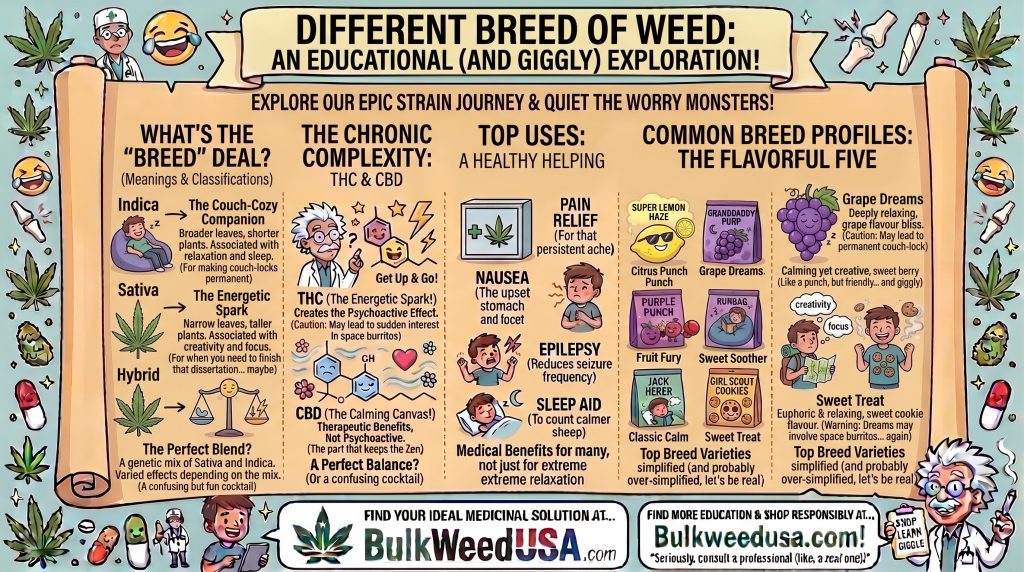
Cannabis is traditionally divided commercially into:
- Sativa
- Indica
- Hybrid
There are also CBD-dominant and other cannabinoid-focused cultivars.
Modern cannabis breeding has complicated these categories substantially.
Decades of crossbreeding mean many contemporary products contain genetic ancestry associated with numerous cannabis lines.
For general educational exploration of cannabis terminology, readers can visit Bulkweedusa.com while relying on government and peer-reviewed scientific sources for health or legal information.
Is “Breed” the Correct Word for Cannabis?
Not usually.
“Breed” is understandable conversational language, but cultivar is often more appropriate when discussing cultivated plants.
Other commonly encountered terms include:
Strain — widely used throughout cannabis culture and commerce.
Cultivar — a cultivated plant variety selected for particular characteristics.
Chemotype — classification according to chemical characteristics.
Phenotype — observable characteristics resulting from genetics and environmental influences.
Genotype — genetic makeup.
Therefore, when someone asks about different breeds of weed, they are generally asking about cannabis cultivars or strains.
The Three Main Commercial Categories
Sativa
Sativa-labeled cannabis is traditionally marketed as:
- Uplifting
- Cerebral
- Daytime-oriented
- Stimulating
Popular sativa-associated names include Sour Diesel, Durban Poison, Jack Herer, and Super Lemon Haze.
Indica
Indica-labeled products are traditionally marketed as:
- Relaxing
- Physically calming
- Evening-oriented
- Sedating
Recognizable names include Northern Lights, Granddaddy Purple, Hindu Kush, and Bubba Kush.
Hybrid
Hybrids represent combinations of cannabis genetic lines.
They may be marketed as:
- Sativa-dominant
- Indica-dominant
- Balanced
Many of today’s most popular weed strains are hybrids.
However, sativa, indica, and hybrid labels should not be treated as guaranteed predictors of effects.
Different Breeds of Weed: 50 Popular Strain Names
The following weed strains list provides examples of widely recognized names in cannabis culture.
It is not a medical ranking or recommendation.
Sativa and Sativa-Dominant Names
- Sour Diesel
- Durban Poison
- Jack Herer
- Super Lemon Haze
- Strawberry Cough
- Amnesia Haze
- Tangie
- Maui Wowie
- Super Silver Haze
- Green Crack
- Clementine
- Mimosa
- Trainwreck
- Acapulco Gold
- Chocolope
Indica and Indica-Dominant Names
- Northern Lights
- Granddaddy Purple
- Hindu Kush
- Afghan Kush
- Bubba Kush
- Purple Kush
- LA Confidential
- Kosher Kush
- Purple Punch
- Slurricane
- Ice Cream Cake
- Critical Kush
- Master Kush
- Death Bubba
- Blackberry Kush
Hybrid Names
- OG Kush
- Blue Dream
- GSC
- GG4
- Gelato
- Wedding Cake
- Pineapple Express
- White Widow
- Chemdawg
- Zkittlez
- Runtz
- Gary Payton
- Do-Si-Dos
- GMO
- MAC
- Animal Cookies
- Sunset Sherbet
- Apple Fritter
- Jealousy
- Permanent Marker
The classification of individual cultivars can differ among producers and databases. That inconsistency is one reason strain names should not be interpreted as standardized scientific categories.
Weed Strain Lookup: What Should You Look For?
A useful weed strain lookup should provide more than a name and a sativa/indica percentage.
Where legally available, useful information can include:
THC Content
THC is cannabis’s primary intoxicating cannabinoid.
CBD Content
CBD is non-intoxicating and can vary considerably among cultivars.
Minor Cannabinoids
Laboratory reports may identify compounds such as:
- CBG
- CBC
- THCV
- CBN
Terpenes
Common cannabis terpenes include:
- Myrcene
- Limonene
- Pinene
- Linalool
- Beta-caryophyllene
- Terpinolene
Laboratory Testing
Legal-market testing can provide information about cannabinoid concentrations and specified contaminants.
Product Type
Flower, concentrates, edibles, tinctures, and vape products cannot be compared solely through strain names.
These characteristics can make a cannabis strain database more informative.
Cannabis Strain Database: Why Names Can Be Confusing
Building a perfectly accurate cannabis strain database is difficult because cannabis strain names are not universally standardized.
Imagine two products labeled Blue Dream.
Producer A might report one THC concentration and terpene profile.
Producer B could report something noticeably different.
Differences can arise from:
- Genetic selection
- Phenotype
- Growing environment
- Harvest timing
- Processing
- Storage
- Laboratory methodology
A strain database is therefore best used for general genetic and cultural information rather than as a guarantee of exact chemical composition.
Readers researching cannabis terminology can also explore educational articles at Bulkweedusa.com.
Most Popular Weed Strains in Cannabis Culture
Several names have achieved particularly strong recognition.
OG Kush
OG Kush became extremely influential in U.S. cannabis breeding and culture.
Numerous modern cultivars have connections with Kush-related genetics.
Blue Dream
Blue Dream became one of the most recognizable hybrids in American cannabis markets.
It is commonly described as sativa-dominant.
Sour Diesel
Sour Diesel remains one of the best-known sativa-associated names.
Northern Lights
Northern Lights has longstanding recognition among indica-associated cultivars.
GSC
GSC became enormously influential in contemporary cannabis genetics.
Gelato
Gelato helped define a newer generation of dessert-named cannabis hybrids.
Wedding Cake
Wedding Cake has become another widely recognized modern hybrid.
Jack Herer
Jack Herer remains a famous sativa-dominant name.
Granddaddy Purple
Granddaddy Purple is widely recognized among purple-colored and indica-associated cannabis cultivars.
Durban Poison
Durban Poison is historically associated with southern African cannabis genetics and remains a familiar sativa name.
These represent popular strains, not scientifically proven superior products.
Best Pot Strains: Is There a Scientific Ranking?
No.
The best pot strains depend entirely on how “best” is defined.
A consumer might prioritize:
- Aroma
- Flavor
- Moderate THC
- High THC
- CBD content
- Genetic history
- Appearance
- Consistency
Someone prioritizing citrus aroma might select a completely different cultivar from someone interested in Kush genetics.
No laboratory test produces a universal “best strain” score.
Best Strains vs. Strongest Strains
Another common misconception is:
Highest THC = best cannabis.
That is incorrect.
Higher THC concentrations can increase intoxicating effects, but greater THC exposure can also increase the likelihood of:
- Anxiety
- Paranoia
- Dizziness
- Cognitive impairment
- Poor coordination
- Uncomfortable intoxication
The CDC Cannabis and Public Health resource provides information concerning THC, impairment, cannabis-related health effects, and problematic cannabis use.
Potency should therefore be considered one characteristic rather than an overall measure of quality.
Different Breeds of Weed and Cannabinoids
Cannabinoids are among the most important chemical components for understanding cannabis.
THC
THC produces most of marijuana’s characteristic intoxicating effects.
CBD
CBD does not produce the characteristic THC high.
CBG
CBG is a minor cannabinoid being investigated scientifically for several potential biological properties.
CBC
CBC is another naturally occurring cannabinoid receiving research attention.
CBN
CBN can occur as THC degrades and is frequently marketed in sleep-related cannabis products, although marketing claims can exceed available clinical evidence.
Different cannabinoid combinations help explain why cannabis cannot be understood solely through strain names.
Different Breeds of Weed and Terpenes
Terpenes contribute significantly to cannabis aroma.
Limonene
Often associated with citrus-like aromas.
Pinene
Associated with pine-like aromas.
Myrcene
Common in cannabis and associated with earthy or herbal aromas.
Linalool
Associated with floral aromas and also found in plants such as lavender.
Beta-Caryophyllene
Often associated with peppery or spicy aroma characteristics.
Terpinolene
Can contribute complex herbal, floral, citrus, or pine-like notes.
A terpene profile can provide more descriptive information about aroma than simply knowing whether cannabis is called indica or sativa.
Sativa vs. Indica: Are They Really Different?
The traditional model suggests:
Sativa = uplifting
Indica = relaxing
Scientific research suggests the situation is considerably more complicated.
Modern cannabis has undergone extensive crossbreeding, and commercial labels do not always correspond neatly with chemical composition.
Peer-reviewed studies available through PubMed examine relationships among cannabis genetics, chemistry, and commercial classifications.
This research reinforces the importance of looking beyond simple category labels.
Pot Strains List: Classic vs. Modern Genetics
Cannabis naming has changed dramatically over time.
Classic Names
Examples include:
- Northern Lights
- Skunk #1
- White Widow
- Durban Poison
- Hindu Kush
- Jack Herer
- Super Silver Haze
These names have longstanding historical importance.
Modern Names
Examples include:
- Gelato
- Runtz
- Wedding Cake
- Gary Payton
- Jealousy
- Permanent Marker
- Ice Cream Cake
- Lemon Cherry Gelato
Modern breeding increasingly involves complex hybrid ancestry.
This makes rigid sativa-versus-indica classification increasingly difficult.
Most Popular Pot Strains and Aroma
Aroma has become a major component of cannabis culture.
Strains may be described as:
- Fruity
- Citrus
- Pine
- Earthy
- Floral
- Peppery
- Fuel-like
- Berry
- Tropical
- Dessert-like
These descriptions can be useful when discussing sensory characteristics.
However, aroma does not determine medical effectiveness.
A cannabis product smelling strongly of citrus is not automatically therapeutic because it contains citrus-associated terpenes.
Does the Strain Name Predict How Cannabis Feels?
Not reliably.
The same cultivar can affect different individuals differently.
Important factors include:
- THC exposure
- CBD content
- Tolerance
- Previous cannabis experience
- Product formulation
- Individual biology
- Other substances
- Medications
Expectations can also influence subjective experiences.
A product marketed as energizing can still make someone tired.
Likewise, an indica-associated cultivar can potentially cause anxiety rather than relaxation.
Different Breeds of Weed and Medical Claims
Cannabis and cannabinoids have been researched for numerous symptoms and conditions.
However, clinical cannabinoid research should not automatically be converted into claims about individual commercial strains.
For example, evidence involving standardized THC/CBD preparations does not establish that Blue Dream, Northern Lights, OG Kush, or another commercial cultivar treats a particular medical condition.
A strain name is not equivalent to an FDA-approved medicine.
Cannabis Smoke and Health
A common method of cannabis consumption involves combustion.
Smoke contains combustion products that can irritate the respiratory system.
A strain being considered premium or high quality does not make smoke harmless.
This is another reason terms such as “best pot strains” should not automatically be interpreted as recommendations for smoking.
Cannabis Strains and Driving
No cannabis strain eliminates THC-related driving impairment.
Cannabis can affect:
- Coordination
- Reaction time
- Judgment
- Attention
- Decision-making
An uplifting or sativa-labeled strain can still impair driving.
Legalization in a state also does not legalize impaired driving.
Cannabis Strain Laws Across the United States
The legality of cannabis differs across the United States.
Some jurisdictions permit adult-use cannabis, others operate medical programs, and others maintain substantial restrictions.
Legal status can also differ between state and federal law.
A weed strain lookup therefore should not be used as a substitute for checking applicable law.
Official state regulators are the appropriate source for current local requirements.
For additional educational cannabis terminology, readers can explore Bulkweedusa.com while confirming legal information through government sources.
Frequently Asked Questions
1. What are different breeds of weed?
The phrase usually refers to different cannabis strains or cultivars. Examples include OG Kush, Blue Dream, Sour Diesel, Northern Lights, Gelato, Wedding Cake, Durban Poison, and Jack Herer.
2. Is “breed” the correct term for weed?
Cultivar, variety, genetic line, chemotype, and strain are generally more precise terms, although “breed” is commonly understood conversationally.
3. What are the most popular weed strains?
Widely recognized names include OG Kush, Blue Dream, Sour Diesel, Northern Lights, GSC, Gelato, Wedding Cake, Jack Herer, Granddaddy Purple, and Durban Poison.
4. What are the best pot strains?
There is no scientifically established best strain. Rankings depend on factors such as genetics, aroma, cannabinoid composition, popularity, and individual preference.
5. What should a weed strain lookup include?
Useful information can include genetics, THC, CBD, minor cannabinoids, terpene profiles, product type, and laboratory testing information.
6. What is a cannabis strain database?
A cannabis strain database organizes information about cannabis cultivars, including names, genetics, classifications, cannabinoids, terpenes, and reported characteristics.
7. What is the difference between sativa and indica?
They are traditional cannabis classifications. Sativa is commonly marketed as uplifting and indica as relaxing, but modern cannabis chemistry does not always follow these categories predictably.
8. Are hybrid weed strains common?
Yes. Extensive crossbreeding means many modern cannabis cultivars are hybrids.
9. Are high-THC strains automatically the best strains?
No. THC concentration indicates intoxicating potency, not overall quality. Higher THC can also increase unwanted effects.
10. Can two cannabis products with the same strain name be different?
Yes. Genetics, phenotype, cultivation, harvesting, processing, storage, and other factors can produce different chemical profiles despite identical strain names.
Educational Resources
The CDC Cannabis and Public Health resource provides federal public-health information concerning THC, impairment, cannabis use, and associated health considerations.
The National Institute on Drug Abuse cannabis resource provides scientific information about marijuana, cannabinoids, potency, and health effects.
For peer-reviewed studies examining cannabis genetics, chemical profiles, and traditional indica/sativa classifications, explore PubMed cannabis strain research.
Final Thoughts on Different Breeds of Weed
Understanding different breeds of weed involves much more than memorizing cannabis names.
OG Kush, Blue Dream, Sour Diesel, Northern Lights, GSC, Gelato, Wedding Cake, Jack Herer, Durban Poison, Runtz, Gary Payton, and hundreds of other cultivars have become recognizable parts of cannabis culture.
However, a weed strains list or cannabis strain database cannot determine which cultivar is universally best.
The most popular weed strains are popular because of combinations of history, genetics, aroma, branding, consumer reputation, and availability—not because science has ranked them above every alternative.
THC, CBD, minor cannabinoids, terpene composition, laboratory results, product condition, and individual response provide additional information that strain names cannot.
For that reason, searches for best pot strains, best strains, most popular pot strains, and pot strains list are most useful when treated as tools for learning about cannabis diversity rather than definitive rankings.
