
Cannabis Education
Drugs Definition
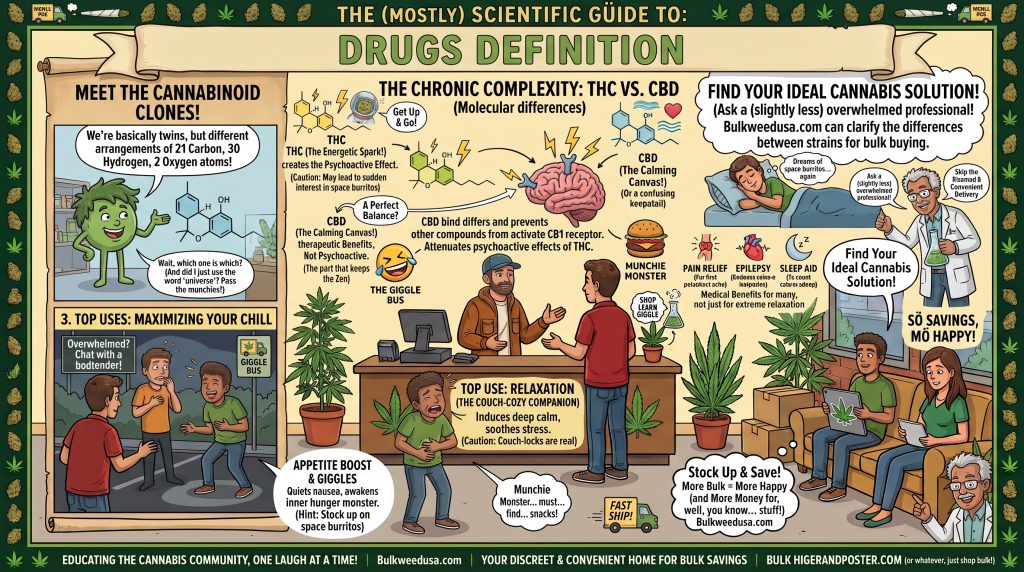
Sep
Drugs Definition: Drug Meaning, Categories, Classifications and Different Types of Drugs
A clear drugs definition starts with an important fact: the word drug does not automatically mean an illegal substance. In medicine and pharmacology, a drug is broadly understood as a substance that can affect the body’s structure, function, chemistry, or physiological processes. Drugs can include prescription medications, over-the-counter medicines, controlled substances, and psychoactive substances used recreationally.
For example, an antibiotic prescribed for an infection is a drug. A pain-relief medication is a drug. Caffeine and nicotine are psychoactive drugs, while substances such as cocaine and heroin also fall within the broad drug category but have very different effects, risks, and legal controls.
Understanding the drugs definition also means looking beyond everyday language. Questions about drug meaning, drugs groups, medication medications, recreational drugs, drugs and types, drug classifications, different types of drugs, drug categories, and drug pills all describe different parts of the same broad subject.
This educational guide explains the terminology, major categories, medical uses, psychoactive effects, and different ways scientists and governments classify drugs.
What Is a Drug?
In general terms, a drug is a substance capable of producing physiological or psychological effects when introduced into the body.
This broad drugs definition includes substances used for medical treatment as well as substances used for recreational or nonmedical purposes.
Drugs can influence processes such as:
- Pain perception
- Mood
- Alertness
- Sleep
- Heart rate
- Blood pressure
- Inflammation
- Infection
- Hormone activity
- Brain signaling
- Digestion
Some drugs are developed specifically as medicines.
Others occur naturally.
Some substances have both legitimate medical applications and significant potential for misuse.
Context therefore matters.
Drug Meaning in Medicine
The drug meaning used in medicine is much broader than the everyday use of the word.
People sometimes hear “drugs” and immediately think about substances such as cocaine, heroin, methamphetamine, or marijuana.
Medical professionals use the term differently.
A medication prescribed to lower blood pressure is a drug.
So is an anesthetic used during surgery.
Other examples include:
- Antibiotics
- Antidepressants
- Antihistamines
- Antiviral drugs
- Pain relievers
- Blood-pressure medicines
- Insulin
- Sedatives
A medically accurate drugs definition therefore includes both therapeutic medicines and many psychoactive substances.
“Drug” and “illegal drug” are not synonyms.
Drug vs. Medication
The terms drug and medication overlap but are not always interchangeable.
A drug is a broad pharmacological concept.
A medication is generally a drug or combination of drugs used to prevent, diagnose, manage, or treat a medical condition.
A useful way to remember the distinction is:
Medications are drugs, but not every drug is being used as a medication.
For example, a prescription stimulant taken according to medical instructions is being used as medication.
The same or a similar psychoactive substance used outside medical supervision can present a very different situation.
Medication Medications and Therapeutic Use
The search phrase medication medications generally refers to substances used therapeutically.
Medicines can be classified according to what they treat.
Examples include:
Analgesics
Used to manage pain.
Antibiotics
Used against susceptible bacterial infections.
Antidepressants
Used for depression and certain other conditions.
Antihistamines
Commonly used for allergic conditions.
Antihypertensives
Used to manage high blood pressure.
Anticonvulsants
Used primarily to prevent or control seizures, although some have other medical applications.
These are therapeutic classifications rather than classifications based primarily on psychoactive effects.
Why Drugs Have Different Classifications
There is no single universal system for categorizing every drug.
A substance can belong to several categories simultaneously.
This is important when interpreting any drugs definition, because substances may be classified according to:
- Medical purpose
- Pharmacological action
- Chemical structure
- Effect on the central nervous system
- Legal status
- Potential for misuse
This explains why two educational resources can show different classification systems without necessarily contradicting each other.
For broader educational information about cannabis and cannabinoid terminology, readers can explore Bulkweedusa.com.
Major Drugs Groups
When substances are classified according to their general effects on the central nervous system, several major drugs groups frequently appear.
These include:
- Stimulants
- Depressants
- Opioids
- Hallucinogens
- Cannabinoids
- Dissociatives
Some classification systems also identify inhalants separately.
Individual substances can produce overlapping effects, so these categories should be treated as educational frameworks rather than perfectly isolated boxes.
Drug Classification Chart
A useful drugs definition becomes clearer when major categories are compared side by side.
| Drug category | General effect or characteristic | Examples |
|---|---|---|
| Stimulants | Increase central nervous system activity | Caffeine, amphetamine, cocaine |
| Depressants | Reduce certain central nervous system activity | Alcohol, benzodiazepines |
| Opioids | Act primarily at opioid receptors | Morphine, fentanyl, heroin |
| Cannabinoids | Interact with cannabinoid systems | THC-containing cannabis |
| Hallucinogens | Can substantially alter perception | LSD, psilocybin |
| Dissociatives | Can alter perception and sense of detachment | Ketamine, PCP |
| Inhalants | Vapors inhaled for psychoactive effects | Certain solvents and gases |
| Therapeutic drug classes | Used for particular medical purposes | Antibiotics, antihypertensives |
This drug classification chart simplifies complex pharmacology. Some substances can fit more than one descriptive category.
Stimulants
Stimulants generally increase activity in parts of the central nervous system.
Possible effects can include:
- Increased alertness
- Increased wakefulness
- Increased heart rate
- Reduced fatigue
- Increased blood pressure
- Reduced appetite
Examples include caffeine, nicotine, cocaine, and amphetamine-type substances.
Some stimulants have legitimate medical applications.
Prescription stimulants, for example, can be used for conditions such as attention-deficit/hyperactivity disorder under appropriate medical supervision.
Cocaine also has limited medical applications despite being widely associated with illicit recreational use.
The category therefore does not determine whether a substance is automatically legal or illegal.
Depressants
Depressants reduce or slow certain central nervous system activities.
Examples can include:
- Alcohol
- Benzodiazepines
- Barbiturates
Possible effects include:
- Relaxation
- Drowsiness
- Reduced anxiety
- Slower reaction time
- Impaired coordination
High doses can become dangerous.
Combining multiple central nervous system depressants can substantially increase risk.
For example, combining opioids with certain sedatives can increase the danger of respiratory depression.
Opioids
Opioids act primarily through opioid receptors.
This category includes medically important pain medications as well as illicit substances.
Examples include:
- Morphine
- Codeine
- Oxycodone
- Hydrocodone
- Fentanyl
- Heroin
Some opioids have essential medical applications, particularly in pain management and anesthesia.
They can also produce dependence, overdose, and potentially fatal respiratory depression.
The risks differ according to the drug, dose, route of administration, tolerance, and whether other substances are involved.
Hallucinogens
Hallucinogens can produce substantial changes in perception, thought, mood, and sensory experience.
Examples include:
- LSD
- Psilocybin
- Mescaline
The term covers substances with different pharmacological mechanisms.
Researchers are also investigating some psychedelic compounds for potential therapeutic applications under controlled clinical conditions.
Clinical research should not be confused with unsupervised recreational use.
Cannabinoids
Cannabinoids interact with the body’s endocannabinoid system.
Cannabis contains numerous naturally occurring cannabinoids, including:
- THC
- CBD
- CBG
- CBC
- CBN
THC is primarily responsible for cannabis intoxication.
CBD has a different pharmacological profile and does not produce the characteristic THC high.
Cannabis laws also vary considerably across the United States.
A substance being legal under a particular state program does not automatically mean it has the same status under federal law.
Recreational Drugs
Recreational drugs are substances used primarily for their psychoactive effects rather than for a medical purpose.
The term can include legal and illegal substances depending on jurisdiction.
Examples may include:
- Alcohol
- Nicotine
- Cannabis
- Cocaine
- MDMA
- Hallucinogens
Therefore, rec drugs should not automatically be interpreted as meaning illegal drugs.
Alcohol is a clear example of a widely used recreational psychoactive drug that is legally available to adults under regulated circumstances.
Cannabis presents a more complicated example because its legal status varies between jurisdictions and between state and federal law.
Why People Use Psychoactive Substances
People may use psychoactive drugs for different reasons, including:
- Medical treatment
- Recreation
- Cultural practices
- Experimentation
- Coping with stress
- Social influences
- Dependence
Understanding these motivations is important in public-health discussions.
Simply labeling someone a “drug user” provides little information about what substance they use, why they use it, how frequently they use it, or their level of risk.
Educational Resources
For federal educational information about drugs, addiction, substance use, prevention, and research, visit the National Institute on Drug Abuse.
For official information about controlled substances, federal drug schedules, and drug classifications in the United States, visit the U.S. Drug Enforcement Administration Drug Scheduling.
For public-health information about substance use, mental health, treatment, prevention, and recovery resources, visit the Substance Abuse and Mental Health Services Administration.
Drug Classifications Under U.S. Federal Law
Another important part of the drugs definition is understanding the difference between scientific classification and legal classification.
Scientific categories describe what substances do.
Legal categories describe how governments regulate them.
Under the U.S. Controlled Substances Act, controlled substances are divided into:
- Schedule I
- Schedule II
- Schedule III
- Schedule IV
- Schedule V
Federal scheduling considers factors such as accepted medical use, abuse potential, and dependence.
The schedule number should not be interpreted as a simple ranking of how dangerous every substance is.
Schedule I
Schedule I substances are federally defined under specific statutory criteria, including high abuse potential and no currently accepted medical use in treatment under the federal framework.
Federal classifications can change.
Anyone researching the legal status of a particular substance should therefore consult current federal information.
Schedule II
Schedule II includes controlled substances that can have accepted medical uses while remaining subject to significant controls.
Examples include certain:
- Opioids
- Stimulant medications
These substances demonstrate why the phrase “controlled substance” does not automatically mean “illegal substance.”
Schedules III Through V
Schedules III, IV, and V contain additional substances and medicines subject to different levels of federal control.
Many are legitimate prescription products.
They can include certain:
- Pain medicines
- Sedatives
- Anti-anxiety medicines
- Other therapeutic drugs
Rules vary according to the substance and schedule.
Different Types of Drugs by Medical Purpose
Another useful way to understand the drugs definition is by examining therapeutic categories.
Medical classifications can include:
- Analgesics — pain
- Antipyretics — fever
- Antibiotics — susceptible bacterial infections
- Antifungals — fungal infections
- Antivirals — viral infections
- Antidepressants — depression and other conditions
- Antipsychotics — psychotic disorders and other indications
- Anticonvulsants — seizures and other conditions
- Antihistamines — allergies and related conditions
- Antihypertensives — high blood pressure
This classification system is often more useful in medicine than simply dividing substances into stimulants and depressants.
Different Kinds of Drugs by Source
Different kinds of drugs can also be described according to their origins.
Naturally Derived
Some originate from plants, fungi, microorganisms, or other natural sources.
Semisynthetic
These begin with naturally occurring compounds that are chemically modified.
Synthetic
These are manufactured through chemical processes.
However, origin does not determine safety.
A naturally occurring substance can be extremely toxic, while a synthetic medicine can be safe and beneficial when appropriately used.
“Natural” and “safe” are not synonyms.
Drug Categories by How They Are Used
Drugs can also be grouped according to their practical use.
Prescription Drugs
Generally require authorization from a licensed healthcare professional.
Over-the-Counter Drugs
Can be purchased without a prescription when used according to labeling and applicable regulations.
Controlled Prescription Drugs
Have accepted medical applications but are subject to additional controls because of misuse or dependence concerns.
Recreational Substances
Used primarily for psychoactive effects.
Illicit Drugs
Possession, production, distribution, or use may be prohibited under applicable law.
This broader framework makes the drugs definition easier to understand because the same compound may fit different categories depending on how it is being used and regulated.
Drug Pills: What Does the Term Mean?
Drug pills is a very broad phrase.
A pill can contain almost any type of oral medication.
Examples include:
- Pain relievers
- Antibiotics
- Antidepressants
- Vitamins
- Antihistamines
- Blood-pressure medications
- Controlled prescription drugs
Physical appearance alone cannot reliably identify a pill.
Two tablets can look similar while containing completely different substances.
Unknown pills should not be consumed based on color, shape, markings seen online, or another person’s claim about what they contain.
Counterfeit Pills and Safety
Counterfeit pills are an important public-health concern.
Illicit tablets can be manufactured to resemble legitimate prescription medications while containing different substances.
This can make visual identification unreliable.
Unexpectedly potent opioids or other compounds can substantially increase overdose risk.
Medication should come from legitimate healthcare and pharmacy channels.
Different Drugs Can Have Similar Effects
Classification becomes complicated because different drugs can produce overlapping effects.
For example:
- Alcohol and benzodiazepines can both produce sedation.
- Opioids can also produce significant sedation.
- Cannabis can impair reaction time despite not fitting neatly into the traditional depressant category.
- Some hallucinogens can produce both stimulating and perceptual effects.
This is why modern pharmacology focuses on mechanisms of action in addition to broad behavioral categories.
Drug Effects Depend on Dose
A basic principle of pharmacology is that dose matters.
The same drug can produce different effects at different doses.
Effects can also depend on:
- Body size
- Age
- Metabolism
- Tolerance
- Health conditions
- Other medications
- Other substances
- Route of administration
A medicine that is beneficial at a therapeutic dose can become dangerous at an excessive dose.
For additional educational information about cannabinoids and cannabis-related drug terminology, readers can explore Bulkweedusa.com.
Drug Interactions
Combining substances can change their effects.
Some combinations can be particularly dangerous.
For example, combining substances that suppress the central nervous system may increase sedation and respiratory risks.
Interactions can occur between:
- Prescription medicines
- OTC products
- Alcohol
- Cannabis
- Supplements
- Recreational substances
Healthcare professionals and pharmacists can help identify important medication interactions.
Drug Dependence and Addiction
A complete drugs definition should also distinguish physical dependence from addiction.
Physical dependence can occur when the body adapts to repeated exposure and withdrawal symptoms appear after stopping.
Addiction, commonly discussed clinically as part of substance-use disorders, involves patterns such as compulsive drug use despite harmful consequences.
Some medications can cause physical dependence when used as prescribed.
That does not automatically mean a patient has an addiction.
Tolerance
Tolerance means a person’s response to a drug decreases after repeated exposure, potentially requiring greater amounts to produce the same effect.
Tolerance can develop with numerous substances.
It becomes especially important when a drug carries overdose, dependence, or withdrawal risks.
Why Legal Status Does Not Define Drug Safety
Legal status is not a reliable measurement of pharmacological safety.
Alcohol is legal for adults but can contribute to poisoning, dependence, accidents, and chronic health problems.
Prescription opioids have legitimate medical applications but can cause fatal overdose if misused.
Some controlled substances are being investigated for possible medical applications.
A useful drugs definition therefore separates legality, medical value, pharmacological effects, and health risks rather than treating them as the same concept.
For more general cannabis education, readers can visit Bulkweedusa.com.
Frequently Asked Questions
1. What is the drugs definition?
A broad drugs definition describes drugs as substances capable of producing physiological or psychological effects in the body. The category includes medications, psychoactive substances, and controlled drugs.
2. What is the meaning of drug?
A drug is a substance that affects biological functions. Some drugs are used as medicines, while others may be used recreationally or have no recognized therapeutic purpose.
3. What are the main drugs groups?
Common psychoactive categories include stimulants, depressants, opioids, cannabinoids, hallucinogens, dissociatives, and inhalants.
4. Are all drugs illegal?
No. Prescription medicines, over-the-counter medications, caffeine, alcohol, and many other legal substances are drugs.
5. What are recreational drugs?
They are substances used primarily for psychoactive effects rather than medical treatment. Their legal status varies by substance and jurisdiction.
6. What are drug classifications?
Drugs can be classified according to pharmacological effects, therapeutic purpose, chemical structure, mechanism of action, or legal status.
7. What is a drug classification chart?
It is a simplified table grouping substances according to characteristics such as central nervous system effects, therapeutic uses, or legal classifications.
8. Are medications considered drugs?
Yes. Medications contain drugs used for therapeutic purposes, although the broader category of drugs includes many nonmedical substances.
9. What are drug pills?
The term can describe almost any drug delivered in tablet or capsule form. Appearance alone should not be used to identify an unknown pill.
10. What is the difference between controlled and illegal drugs?
A controlled substance is subject to legal restrictions. Many controlled substances are legitimate prescription medications, so controlled does not automatically mean illegal.
Final Thoughts
A useful drugs definition goes far beyond the assumption that drugs are simply illegal substances.
Drugs include an enormous range of compounds capable of changing biological or psychological processes. Some save lives as medications. Some alter mood or perception. Others can produce dependence, poisoning, or overdose when misused.
Understanding drug meaning, drugs groups, recreational drugs, drug classifications, different types of drugs, different kinds of drugs, and drug categories requires looking at several classification systems.
Doctors may categorize medicines according to what they treat.
Pharmacologists may classify substances according to their biological mechanisms.
Public-health researchers may focus on risks and patterns of use.
Governments may categorize controlled substances through legal schedules.
The drugs definition therefore depends partly on context, but the central idea remains consistent: a drug is a substance capable of affecting biological or psychological functions.
Learning these distinctions makes it easier to understand medicines, recreational substances, controlled drugs, health risks, and the many different ways drugs are classified.
