
Cannabis Education
What Is Hemp?
Sep
What Is Hemp? Cannabis, THC, CBD and U.S. Hemp Rules Explained
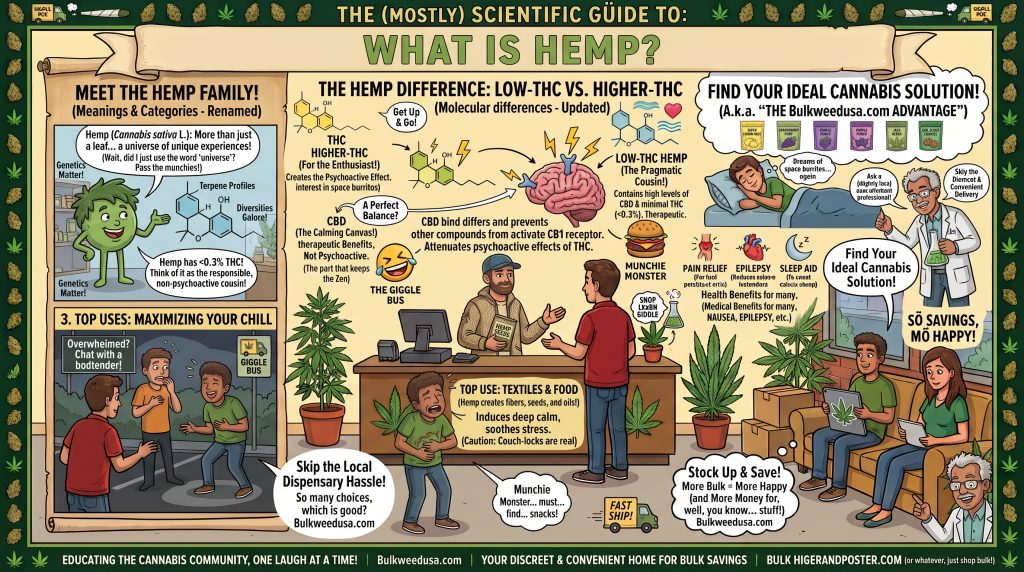
What is hemp? Hemp is cannabis that meets a specific legal THC definition. Although hemp and marijuana both come from cannabis plants, U.S. law has historically distinguished them mainly through THC concentration.
Hemp can contain CBD, THC, terpenes and other cannabinoids. It is therefore inaccurate to describe hemp simply as cannabis with no THC. Industrial hemp is commonly used for fiber, seed, food, building materials and cannabinoid production, while marijuana is more commonly associated with medical or adult-use cannabis containing higher concentrations of intoxicating THC.
Understanding the distinction requires looking at plant biology, cannabinoid concentration, federal law and the type of finished product.
Plant Biology
Hemp and marijuana can both come from Cannabis sativa.
They may have similar:
- Leaves
- Flowers
- Aromas
- Trichomes
- Growth characteristics
Visual appearance alone cannot reliably establish the legal category of a cannabis plant.
Laboratory analysis is necessary to determine cannabinoid concentrations accurately.
Federal Classification
Federal law has historically separated qualifying hemp from marijuana primarily through THC concentration.
Under the federal framework operating through much of 2026, qualifying hemp generally remains associated with a delta-9 THC concentration of no more than 0.3% on a dry-weight basis.
Federal requirements are evolving, however, and newer provisions are scheduled to change how THC is calculated and how certain cannabinoid products are treated.
Because regulations can change, current USDA and other federal guidance should be checked when legal status matters.
THC Concentration
One misconception is that hemp contains no THC.
It can contain THC.
The important question is the concentration and how current law treats the material or product.
THC levels can depend on:
- Plant genetics
- Environmental conditions
- Harvest timing
- Processing
- Formulation
- Testing methodology
Low-THC plant material therefore should not be confused with completely THC-free material.
Can Low-THC Cannabis Cause Intoxication?
Traditional industrial varieties generally contain much less intoxicating THC than marijuana cultivated for high-THC flower.
However, finished cannabinoid products are a separate issue.
Certain gummies, beverages, concentrates and other products made from qualifying plant material may contain psychoactive cannabinoids.
That means the source being described as hemp does not automatically guarantee that a finished consumer product is non-intoxicating.
The actual cannabinoid dose matters.
CBD and Other Cannabinoids
Cannabidiol, commonly called CBD, is frequently extracted from low-THC cannabis.
CBD does not produce the characteristic intoxication associated with delta-9 THC.
Plants and extracts may nevertheless contain several cannabinoids simultaneously, including:
- CBD
- THC
- CBG
- CBC
- CBN
For broader educational information about cannabis compounds, readers can explore Bulkweedusa.com.
Industrial Uses
Cannabis grown within the agricultural hemp framework can have many uses beyond CBD.
Common applications include:
- Fiber
- Rope
- Textiles
- Paper
- Hemp seed
- Food ingredients
- Protein products
- Seed oil
- Animal bedding
- Building materials
This agricultural history is one reason the crop should not be viewed exclusively through the modern cannabinoid-products market.
Seeds and Extracts Are Different
Hemp seed oil should not automatically be confused with CBD oil.
Seeds naturally contain very little cannabinoid material compared with resin-rich flowers.
Hemp-seed products can include:
- Seed oil
- Protein powder
- Hemp hearts
- Food ingredients
CBD extracts, by contrast, usually come from cannabinoid-rich plant material.
Understanding that distinction can help consumers interpret product labels correctly.
Cannabis Terminology
People often use words such as hemp, weed, marijuana and cannabis as though they are completely separate botanical terms.
They are not.
Cannabis is the broader plant term.
“Weed” is informal terminology commonly associated with marijuana.
Hemp is principally a legal and agricultural classification.
This is why asking what is hemp cannot be answered only by looking at the shape of the plant.
THC From Qualifying Plant Material
“Hemp-derived THC” generally describes THC originating from cannabis material that qualifies under the relevant hemp definition.
This became particularly important after the 2018 Farm Bill because manufacturers developed cannabinoid products containing substances such as:
- Delta-8 THC
- Delta-9 THC
- THCA
- Other cannabinoid derivatives
Some of these products can cause intoxication.
Origin and psychoactive effect are therefore separate questions.
Educational Resources
For official U.S. information about agricultural production and federal requirements, visit the USDA Hemp Program.
For federal information concerning CBD, cannabis-derived products and food or drug regulation, visit the U.S. Food and Drug Administration.
For federal legislative research concerning cannabis and agricultural policy, review materials from the Congressional Research Service.
Federal Policy Changes
The 2018 Farm Bill created the modern federal agricultural framework by excluding qualifying low-THC cannabis from the federal marijuana definition.
The commercial market changed considerably afterward.
Products containing delta-8 THC, hemp-derived delta-9 THC and other cannabinoids became increasingly common.
Congress later approved changes intended to tighten the federal definition and account more directly for total THC and certain intoxicating cannabinoid products.
Anyone publishing legal cannabis information should therefore include dates and avoid presenting the regulatory framework as permanently fixed.
State Rules Matter Too
Federal status is only one part of the legal picture.
States can establish additional requirements concerning:
- THC products
- CBD products
- Delta-8
- THCA
- Retail licensing
- Product testing
- Packaging
- Age restrictions
A cannabinoid product potentially permitted under one legal framework may still be restricted by another.
Product Testing
Laboratory testing can provide information about:
- Delta-9 THC
- CBD
- Other cannabinoids
- Contaminants
- Pesticides
- Residual solvents
Testing is particularly important because visually similar cannabis plants can contain substantially different cannabinoid profiles.
Consumers should not rely solely on terms printed prominently on packaging.
Drug Testing
Low-THC or cannabinoid products can still matter for workplace drug testing.
Many drug tests detect THC metabolites rather than attempting to determine whether the THC originated from hemp or marijuana.
Products containing detectable THC may therefore potentially contribute to a positive result.
Consumer Safety
Legal classification does not guarantee product safety.
Quality can vary according to manufacturing, formulation and testing.
Possible concerns include:
- Incorrect labeling
- Unexpected THC concentration
- Contaminants
- Residual solvents
- Drug interactions
- Impairment from intoxicating cannabinoids
Consumers should evaluate the actual product rather than assuming that an agricultural designation guarantees a particular safety profile.
For more educational information about cannabis products and terminology, readers can visit Bulkweedusa.com.
Frequently Asked Questions
1. What is hemp?
What is hemp? It is cannabis that meets the applicable legal requirements for classification as hemp, historically based largely on a low THC threshold.
2. Is it marijuana?
Qualifying hemp is legally distinguished from marijuana under federal law even though both belong to cannabis.
3. Does it contain THC?
Yes. Low-THC cannabis can contain THC without necessarily exceeding the applicable legal threshold.
4. Can it cause a high?
Traditional industrial varieties contain relatively little THC. However, some concentrated or formulated cannabinoid products can be intoxicating.
5. What separates it from marijuana?
The most important legal distinction has historically been THC concentration, although current federal rules are evolving.
6. Can it contain CBD?
Yes. Low-THC cannabis is a major commercial source of CBD.
7. What does hemp-derived THC mean?
It generally describes THC originating from cannabis material classified under the hemp framework.
8. Are all products federally legal?
No. Product type, cannabinoid concentration, FDA rules and other federal requirements can matter.
9. Can state law be stricter?
Yes. States can impose additional restrictions on cannabinoid products.
10. Can these products affect a drug test?
Products containing THC may potentially result in detectable THC metabolites.
Final Thoughts
So, what is hemp in practical terms?
It is cannabis placed within a particular agricultural and legal category rather than an entirely separate plant unrelated to marijuana.
The most useful distinctions involve THC concentration, cannabinoid profile, intended use and regulatory status.
Traditional industrial varieties are generally associated with low THC and uses such as fiber, seed and food. Modern cannabinoid manufacturing has complicated that picture because some finished products derived from qualifying material can still contain intoxicating cannabinoids.
Consumers should therefore look beyond labels and consider cannabinoid testing, dosage, state rules and current federal requirements.
For educational purposes, what is hemp is best answered by separating the plant itself from the legal classification and from the composition of the final consumer product.
