
Cannabis Education
Cannabis Delivery
Aug
Cannabis Delivery in the USA: Online Dispensaries, Rec Pot Shops and How Legal Delivery Works
Cannabis delivery has become part of the regulated marijuana market in several U.S. states, allowing eligible consumers to place orders with licensed retailers where state and local law permit it. Searches for rec pot shops, most trusted online dispensary, where to buy ganja, weed online shopping, medical weed dispensary, best online weed dispensary, weed warehouse, and online weed store often come from people trying to determine which online cannabis services are legitimate.
The important distinction is between a licensed local cannabis retailer offering lawful delivery and a website claiming it can ship marijuana anywhere in the United States.
Those are not the same thing.
Legal cannabis delivery generally operates within a state’s regulated cannabis system. Rules can determine who may sell, where deliveries may go, how customer age is verified, what products can be offered, and whether municipalities can restrict cannabis businesses.
Consumers should therefore begin with their state cannabis regulator—not with claims such as “best online dispensary” or “nationwide weed shipping.”
What Is Cannabis Delivery?
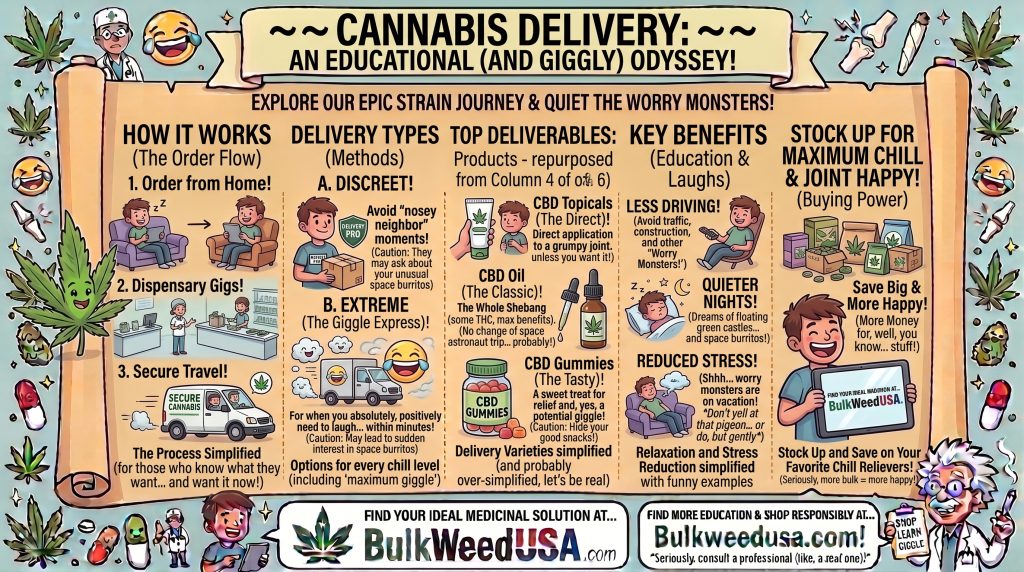
Cannabis delivery is a regulated retail model in which an authorized cannabis retailer accepts an eligible customer’s order and delivers the products to an address permitted by applicable law.
Depending on the state, an order may be placed through:
- A licensed dispensary website
- A retailer’s mobile platform
- An authorized ordering platform
- Telephone ordering
The specific rules vary considerably.
For example, California recognizes both storefront retailers and non-storefront delivery-only retailers. A Type 9 non-storefront retailer sells cannabis to customers through delivery, while a Type 10 storefront retailer can operate a physical store and may also provide delivery.
This demonstrates why an attractive website alone is not enough to establish legality.
Cannabis Delivery Is Not the Same as Nationwide Marijuana Shipping
One of the most important points in cannabis delivery education is the distinction between local regulated delivery and interstate shipping.
A legal cannabis delivery business typically operates according to the rules of the state where it is licensed.
Consumers should be skeptical of websites advertising conventional marijuana products with statements such as:
- Nationwide marijuana shipping
- Ship weed to all 50 states
- No ID required
- Discreet marijuana shipping anywhere
- No state restrictions
Those claims should trigger additional verification rather than immediate trust.
A professional-looking website is not proof of cannabis licensure.
Rec Pot Shops: What Does the Term Mean?
Rec pot shops is an informal term for recreational or adult-use cannabis retailers.
Where adult-use cannabis sales are legal, licensed retailers may sell eligible cannabis products to adults who satisfy the jurisdiction’s age requirements.
The legal age for adult-use purchases is commonly 21, although medical cannabis systems can operate under different requirements.
A recreational dispensary may operate as:
- A storefront
- A delivery retailer
- A storefront offering delivery
- Another state-authorized retail structure
Not every state permits recreational cannabis, and local rules can impose additional restrictions.
Cannabis Delivery and Local Laws
State legalization does not necessarily mean cannabis delivery is identical in every city.
California provides a useful example.
State regulators license cannabis businesses, but cities and counties retain significant authority over which cannabis businesses can operate locally.
Some jurisdictions allow storefront retail and delivery.
Others restrict particular business categories.
This creates substantial variation even within a legal cannabis state.
Consumers should therefore verify both state rules and relevant local requirements.
Most Trusted Online Dispensary: What Should Trust Mean?
There is no official nationwide award identifying the most trusted online dispensary.
Trust should instead be based on verifiable characteristics.
Active Cannabis License
The business should hold the license required by its jurisdiction.
Clear Business Identity
Consumers should be able to identify the actual licensed retailer behind an online storefront.
Age Verification
Legitimate adult-use businesses should follow applicable age-verification requirements.
Regulated Products
Legal-market products should follow applicable testing, labeling, packaging, and tracking rules.
Transparent Product Information
Consumers should be able to determine what they are ordering and who is legally selling it.
No Suspicious Nationwide Claims
Claims that ordinary high-THC marijuana can simply be mailed throughout the country deserve scrutiny.
A “trusted” dispensary should be trusted because its regulatory status can be independently verified—not because a website says it is trusted.
How to Verify Cannabis Delivery
Before using a cannabis delivery service, look for the retailer in the appropriate official state database.
California’s Department of Cannabis Control maintains a license-search system that is updated daily.
Consumers can use it to:
- Verify a cannabis business
- Check license status
- Find licensed retailers
- Review identifying business information
An active license indicates that the business is currently authorized to conduct activities permitted under that license.
This is substantially more reliable than relying exclusively on online reviews.
Where to Buy Ganja Legally
The phrase where to buy ganja should be approached through applicable state law.
Where adult-use cannabis is legal, adults who meet the legal requirements should use state-authorized retailers.
Where only medical cannabis is permitted, access can depend on medical-program requirements.
Where retail marijuana remains prohibited, an online seller claiming it can bypass local restrictions should not be assumed legitimate.
The safest educational rule is straightforward:
Verify the retailer through the official state cannabis regulator before relying on its website.
For broader cannabis terminology and legal-market education, readers can explore Bulkweedusa.com while using government regulators to verify current laws and businesses.
Weed Online Shopping: How Legal Online Ordering Works
Weed online shopping in regulated markets can resemble ordinary e-commerce, but the regulatory environment is very different.
A consumer may:
- Visit a licensed retailer’s website.
- Review products legally available from that retailer.
- Complete required age or eligibility steps.
- Place an order according to state rules.
- Select permitted pickup or delivery options.
- Complete required identity verification.
Exact procedures vary by jurisdiction.
Cannabis should therefore not be treated like an ordinary consumer product that can automatically be ordered from any website and sent anywhere.
Cannabis Delivery in California
California provides one of the clearest examples of a regulated cannabis delivery framework.
California’s Department of Cannabis Control recognizes:
Type 9 — Non-storefront retailer
This business sells cannabis goods to customers through delivery rather than operating a traditional customer-facing storefront.
Type 10 — Storefront retailer
This retailer operates a physical cannabis store and may also provide delivery.
California retailers can sell cannabis products only when operating under appropriate licensing requirements.
State regulations also govern delivery activities.
Consumers can use the state’s licensing resources to verify whether a retailer has an active license.
California Cannabis Delivery and Technology Platforms
Online platforms can complicate the question of who actually sells cannabis.
California’s 2026 regulations address deliveries facilitated through technology platforms.
When a platform facilitates cannabis sales, customers must still be able to identify the licensed retailer or microbusiness responsible for the cannabis goods.
The retailer’s legal business name and license number must be disclosed in circumstances specified by the regulations.
This is an important consumer-protection concept:
Know which licensed business is actually selling the cannabis.
Do not assume the name of an app or marketplace is necessarily the licensed retailer.
Cannabis Delivery in New York
New York also permits regulated adult-use cannabis delivery.
New York’s Office of Cannabis Management states that adult-use cannabis delivery customers must be at least 21.
ID verification is required.
New York also restricts where deliveries may be made.
Permitted destinations include qualifying physical addresses within New York State, while delivery is prohibited at various locations such as public spaces, school grounds, day-care centers, and vehicles.
The state’s rules illustrate how cannabis delivery remains much more regulated than conventional online retail.
Finding Licensed New York Dispensaries
New York maintains an official legal-retailer resource through its Office of Cannabis Management.
Consumers can use the state’s official system to identify authorized medical and adult-use dispensaries rather than relying entirely on search-engine rankings.
This matters because an unlicensed website can imitate the appearance of a legitimate dispensary.
Official verification provides stronger evidence.
Medical Weed Dispensary vs. Recreational Dispensary
A medical weed dispensary operates within a state’s medical cannabis framework.
Medical and recreational systems can differ in several ways.
| Feature | Medical Cannabis | Adult-Use Cannabis |
|---|---|---|
| Eligibility | State medical requirements may apply | Usually adults 21+ where legal |
| Registration | May require patient enrollment | Usually no medical registration |
| Products | State-dependent | State-dependent |
| Delivery | Depends on state rules | Depends on state/local rules |
| Purchase limits | Program-specific | Adult-use limits apply |
| Retailer | Authorized medical retailer | Licensed adult-use retailer |
Some businesses may participate in both systems where state law permits it.
A consumer should not assume that a medical dispensary in one state operates under the same rules as a medical dispensary elsewhere.
Best Online Weed Dispensary: How to Evaluate One
The best online weed dispensary is not necessarily the website with the biggest menu or lowest advertised price.
For legal-market consumers, more useful criteria include:
License Verification
Can the business be confirmed through an official regulator?
Product Testing
Are products subject to applicable state testing requirements?
Label Transparency
Are cannabinoid concentrations and required warnings clearly presented?
Business Identity
Is the actual retailer easy to identify?
Legal Delivery Area
Does the business clearly explain where it is authorized to deliver?
Age Controls
Does it follow applicable age-verification requirements?
Consumer Safety Information
Does it provide responsible-use information instead of presenting cannabis as risk-free?
These factors provide a more meaningful definition of “best.”
Weed Warehouse: Warehouse Does Not Mean Dispensary
The phrase weed warehouse can be misleading.
Cannabis businesses can perform very different regulated activities.
Depending on the jurisdiction, a facility might be associated with:
- Distribution
- Storage
- Manufacturing
- Cultivation
- Retail fulfillment
That does not necessarily mean consumers can purchase cannabis there.
For example, California requires particular licenses for specific commercial cannabis activities.
A distribution facility is not automatically a consumer dispensary.
Consumers should identify whether the business actually possesses authorization for retail sales.
Online Weed Store: Red Flags to Watch For
An online weed store should not automatically be trusted because it ranks highly in search results.
Potential warning signs include:
No License Information
The seller provides no independently verifiable regulatory identity.
Nationwide Marijuana Shipping Claims
The website presents regulated marijuana as though it were ordinary interstate e-commerce.
No Age Verification
The business appears willing to sell adult-use cannabis without meaningful age controls.
Unclear Business Location
The site does not identify the jurisdiction in which its cannabis retailer is licensed.
Cryptocurrency-Only or Unusual Payment Pressure
Payment methods alone do not prove illegitimacy, but unusual payment demands combined with missing licensing information deserve scrutiny.
Social-Media-Only Sellers
An account claiming to sell cannabis is not automatically a licensed dispensary.
The critical question remains:
Can the seller’s retail authorization be independently verified?
Cannabis Delivery and Laboratory Testing
Regulated cannabis systems commonly impose product-testing requirements.
Testing requirements vary by jurisdiction but can involve areas such as:
- Cannabinoid potency
- Pesticides
- Microbial contamination
- Heavy metals
- Residual solvents
- Other contaminants
California, for example, requires cannabis goods sold by retailers to have passed required testing and quality-assurance review.
Testing does not make cannabis risk-free, but it is an important distinction between regulated products and products from unknown sources.
Why Certificates of Analysis Matter
A Certificate of Analysis, commonly called a COA, reports laboratory information about a tested product.
Depending on the jurisdiction and test, a COA can provide information about:
- THC
- CBD
- Other cannabinoids
- Contaminant testing
- Batch identification
New York advises consumers to look for required regulated-product indicators and provides mechanisms for checking laboratory information associated with products.
A COA should be connected to the actual product or batch rather than treated as a generic marketing document.
Cannabis Delivery and THC Potency
Legal delivery does not make high-THC products harmless.
THC can affect:
- Attention
- Memory
- Coordination
- Reaction time
- Judgment
Greater THC exposure can also increase the possibility of unpleasant effects such as anxiety, confusion, dizziness, or paranoia.
Consumers should not interpret “premium,” “top shelf,” or “high potency” as synonyms for safer cannabis.
Cannabis Delivery and Driving
A particularly important rule applies regardless of strain or retailer:
Do not drive while impaired by cannabis.
Having cannabis legally delivered to a residence does not change the risks associated with THC impairment.
Likewise, a product marketed as sativa, uplifting, or energizing can still impair driving ability.
Cannabis Delivery and Minors
Adult-use cannabis delivery is not intended for minors.
Legal systems use age controls to restrict access.
For example, New York requires adult-use delivery customers to be 21 or older and requires identification verification at delivery.
California likewise restricts adult-use retail purchases to adults 21 and older, while its medicinal system has separate eligibility provisions.
Can Cannabis Delivery Cross State Lines?
Consumers should distinguish state-authorized local delivery from interstate commerce.
A retailer authorized to deliver cannabis within a state should not automatically be assumed authorized to send marijuana across state borders.
For example, California’s current delivery regulations specify delivery to a physical address in California.
New York similarly requires its regulated delivery destinations to be within New York State.
This is why searches for the most trusted online dispensary should prioritize state licensing rather than websites promising broad interstate delivery.
Cannabis Delivery and Local Availability
Even in states with legal adult-use cannabis, retail availability can vary.
California illustrates this clearly.
Its Department of Cannabis Control reported in 2026 that many cities and counties still do not allow retail cannabis businesses.
Local restrictions can therefore affect:
- Storefront availability
- Delivery operations
- Business locations
- Operating conditions
The existence of statewide legalization does not guarantee that every type of cannabis business operates everywhere.
How to Research a Cannabis Delivery Service
A useful verification process focuses on regulatory information rather than promotional claims.
Start with the official cannabis regulator for the relevant state.
Then:
- Find the state’s license-search tool.
- Search the retailer’s legal business name.
- Check whether the license is active.
- Confirm that the license authorizes retail activity.
- Compare the licensed identity with the website.
- Review the retailer’s permitted delivery area.
- Examine product labeling and testing information.
This approach can reduce the risk of mistaking an unlicensed seller for a legitimate dispensary.
For additional cannabis education and terminology, readers can explore Bulkweedusa.com.
Cannabis Delivery Is Different Across the USA
There is no single nationwide recreational marijuana delivery system.
Cannabis laws vary substantially among states.
Some jurisdictions allow:
- Adult-use retail
- Medical cannabis
- Delivery
- Storefront sales
Others permit only some of these activities.
Local governments can sometimes impose additional restrictions.
Consumers should therefore check current rules rather than assuming that cannabis delivery available in California or New York operates identically elsewhere.
Educational Resources
For information about licensed dispensaries, adult-use cannabis, medical cannabis, and regulated delivery in New York, visit the New York Office of Cannabis Management. This is the state’s official source for current cannabis regulations and consumer guidance.
For evidence-based information about THC, cannabis impairment, driving, health effects, and responsible-use considerations, explore the CDC Cannabis and Public Health resource.
Frequently Asked Questions
1. What is cannabis delivery?
Cannabis delivery is a regulated retail service available in some jurisdictions that allows eligible customers to order cannabis from authorized retailers for delivery to permitted addresses.
2. Are rec pot shops legal?
Recreational cannabis shops are legal only where applicable state and local laws authorize them. Retailers generally need appropriate licensing.
3. How can I find the most trusted online dispensary?
Rather than relying on rankings, verify the retailer through the official state cannabis regulator and confirm its license status.
4. Where to buy ganja legally?
In jurisdictions permitting cannabis sales, use appropriately licensed retailers and verify them through the relevant state regulator.
5. Is weed online shopping legal?
Online ordering can be legal when conducted through appropriately licensed businesses under applicable state and local regulations.
6. What is a medical weed dispensary?
A medical cannabis dispensary is an authorized retailer operating within a state’s medical cannabis program. Patient eligibility and purchasing requirements vary by state.
7. What is the best online weed dispensary?
There is no universal best dispensary. Licensing, testing, transparent labeling, regulatory compliance, and consumer protections are better evaluation criteria than promotional rankings.
8. Is a weed warehouse the same as a dispensary?
Not necessarily. A warehouse or distribution facility may not possess authorization to sell cannabis directly to consumers.
9. Can an online weed store ship marijuana throughout the USA?
Do not assume so. State-authorized delivery generally operates within specific jurisdictional limits, and claims of unrestricted nationwide marijuana shipping should be carefully scrutinized.
10. How do I know whether cannabis delivery is licensed?
Search the business through the official cannabis licensing database maintained by the regulator in the relevant state.
Final Thoughts on Cannabis Delivery
Cannabis delivery can provide a regulated method of accessing legal-market cannabis in U.S. jurisdictions that authorize the service, but online availability should never be confused with universal legality.
Searches for rec pot shops, most trusted online dispensary, where to buy ganja, weed online shopping, medical weed dispensary, best online weed dispensary, weed warehouse, and online weed store should begin with one question:
Is the retailer actually licensed?
Official state databases provide a much stronger answer than advertisements, reviews, social-media profiles, or claims about being the “best” dispensary.
Consumers should also understand the difference between local delivery and interstate shipping, check age and eligibility requirements, review product testing and labeling information, and verify current state and local rules.
Ultimately, trustworthy cannabis delivery depends on licensing, regulatory compliance, transparent business identity, product testing, responsible age controls, and operating within the jurisdiction where the retailer is authorized.
For broader cannabis education, readers can explore Bulkweedusa.com while using official government regulators as the primary source for current legal and licensing information.
