
Cannabis Education
Does CBD Make You High
Sep
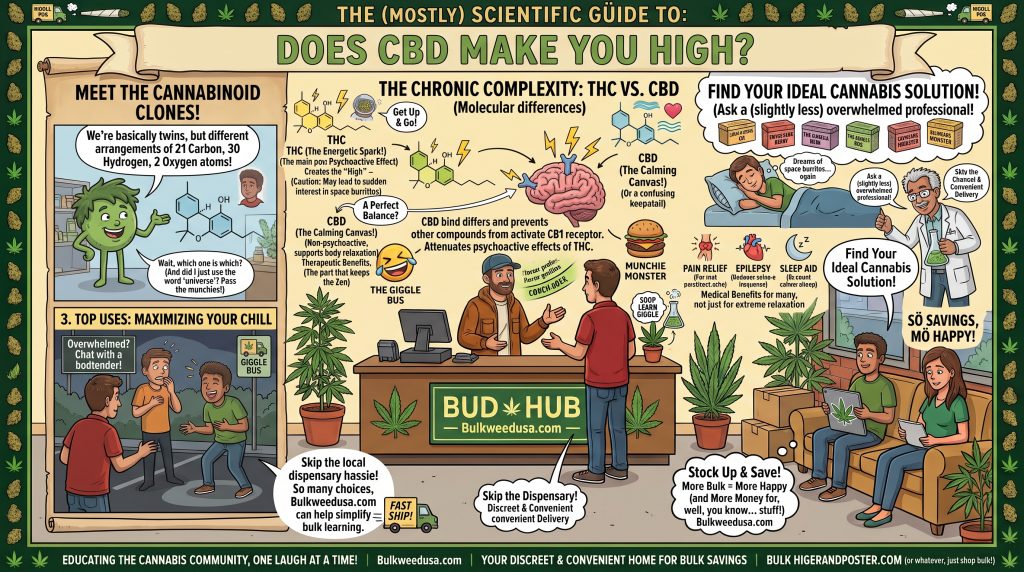
Does CBD Make You High? Effects, Benefits, THC Differences and Safety
Does CBD make you high? No—CBD itself does not produce the classic intoxicating marijuana high associated with THC. CBD, short for cannabidiol, is a naturally occurring compound found in cannabis and hemp. Although it can affect the body and may cause side effects, its effects differ significantly from those of THC.
That distinction is important because CBD products now appear in oils, gummies, capsules, creams, beverages, and cannabis flower. Consumers may also encounter full-spectrum, broad-spectrum, and CBD-isolate formulations, each of which can have a different cannabinoid profile.
Questions such as what is CBD, what does CBD stand for, what does CBD do to you, CBD oil benefits, CBD benefits, CBD weed, CBD effects, and CBD gummies benefits often appear together because people want to understand whether cannabidiol is intoxicating, therapeutic, or simply another form of marijuana.
This guide explains how CBD differs from THC, what current evidence suggests, possible side effects, drug interactions, product labeling, and why the actual cannabinoid content of a product matters.
What Is CBD?
CBD stands for cannabidiol.
It is one of many cannabinoids naturally produced by Cannabis sativa. The two best-known cannabinoids are CBD and THC, but they behave differently in the human body.
THC is primarily responsible for marijuana intoxication.
CBD is generally described as non-intoxicating.
That means cannabidiol does not normally produce effects such as the euphoric marijuana high, major perceptual changes, or the intoxication commonly associated with THC.
However, saying CBD is non-intoxicating does not mean it is biologically inactive.
CBD can affect the body, interact with medications, and cause unwanted effects in some people.
CBD and THC Are Not the Same
Understanding the difference between cannabidiol and THC provides the clearest answer to does CBD make you high.
| Feature | CBD | THC |
|---|---|---|
| Full name | Cannabidiol | Delta-9-tetrahydrocannabinol |
| Classic marijuana high | No | Yes |
| Intoxicating | Generally no | Yes |
| Found in cannabis | Yes | Yes |
| Can affect the body | Yes | Yes |
| Can cause side effects | Yes | Yes |
| Medical research exists | Yes | Yes |
THC activates cannabinoid receptors in ways strongly associated with intoxication.
CBD has a different pharmacological profile and does not produce THC’s characteristic high.
For additional educational information about cannabinoids, cannabis terminology, and THC, readers can explore Bulkweedusa.com.
What Does CBD Do to You?
The phrase what does CBD do to you does not have one universal answer.
Effects vary according to factors such as:
- Amount consumed
- Product formulation
- Other cannabinoids present
- Individual sensitivity
- Medications
- Frequency of use
- THC content
Some people report feeling relaxed after using cannabidiol products. Others may notice little.
Possible effects or side effects can include:
- Drowsiness
- Changes in alertness
- Diarrhea
- Changes in appetite
- Gastrointestinal discomfort
- Medication interactions
The experience should not be confused with THC intoxication.
Why Some CBD Products Can Still Cause Intoxication
One reason consumers ask does CBD make you high is that some products labeled prominently as CBD may contain THC.
CBD itself is not responsible for the traditional marijuana high, but the final product may contain other cannabinoids.
This is particularly relevant with:
- Full-spectrum CBD
- CBD-rich cannabis flower
- Gummies containing CBD and THC
- Poorly labeled products
- Products containing delta-8 THC
- Products containing other intoxicating cannabinoids
Therefore, consumers should examine the complete cannabinoid profile rather than relying only on the letters “CBD” on the package.
Full-Spectrum, Broad-Spectrum and Isolate
CBD products are often divided into three categories.
Full-Spectrum
Full-spectrum formulations generally contain CBD along with other naturally occurring cannabis compounds. Depending on the product, this can include some THC.
Broad-Spectrum
Broad-spectrum formulations are generally marketed as containing multiple cannabinoids while removing THC.
Accurate manufacturing and testing still matter.
CBD Isolate
CBD isolate is intended to contain highly purified cannabidiol with other cannabinoids substantially removed.
Someone who wants to minimize THC exposure should understand these distinctions and review available laboratory information.
CBD Weed Explained
CBD weed usually refers to cannabis or hemp flower bred to contain substantial CBD and relatively little THC.
It may look and smell similar to high-THC marijuana.
Appearance alone cannot reliably determine cannabinoid composition.
Two flowers can look nearly identical while containing very different THC levels.
Laboratory information is therefore more useful than visual inspection.
CBD-rich flower may still contain some THC, so consumers concerned about intoxication or drug testing should not assume the product contains zero THC.
CBD Oil Benefits: What Is Established?
Claims about CBD oil benefits range from reasonable scientific discussion to extreme marketing.
One important fact is well established: a purified prescription form of CBD has received FDA approval for specific seizure disorders.
This demonstrates that cannabidiol has real pharmacological activity.
However, FDA approval of a standardized prescription medication does not mean ordinary retail CBD oils are approved treatments for every condition advertised online.
Research continues in areas such as:
- Pain
- Anxiety
- Sleep
- Inflammation
- Neurological conditions
Evidence differs greatly from one condition to another.
CBD Benefits and Medical Claims
Consumers should distinguish between three levels of evidence:
Established Uses
Some highly standardized cannabinoid medicines have regulatory approval for specific conditions.
Emerging Research
Researchers continue investigating CBD for several potential therapeutic applications.
Marketing Claims
Commercial websites may claim CBD treats conditions far beyond what high-quality evidence supports.
These categories should not be treated as equivalent.
Statements such as “CBD may be under investigation for a condition” are very different from claiming “CBD cures the condition.”
Pain and Cannabidiol Research
CBD and other cannabinoids have attracted attention in chronic-pain research.
However, studies frequently evaluate different formulations.
Some research involves CBD alone.
Other studies involve:
- THC
- THC/CBD combinations
- Cannabis-based medicines
- Standardized cannabinoid preparations
A positive study involving THC and CBD together does not automatically prove that CBD alone provides the same benefit.
People considering cannabinoids specifically for pain should discuss the evidence, medications, and potential risks with a qualified healthcare professional.
Anxiety and Stress Research
CBD is frequently marketed for anxiety and stress.
Some early human research has produced potentially interesting findings, but the evidence varies according to dose, population, formulation, and study design.
Retail CBD should not automatically be treated as a substitute for established anxiety treatment.
Someone experiencing persistent or severe anxiety should obtain appropriate professional guidance rather than relying entirely on cannabinoid marketing.
Sleep and CBD
Many nighttime products advertise possible CBD benefits for sleep.
CBD may cause drowsiness in some users, but feeling sleepy after taking something does not necessarily establish it as a clinically proven treatment for insomnia.
Sleep problems can also have many underlying causes.
Anyone experiencing persistent sleep problems should consider appropriate medical evaluation.
Educational Resources
For federal information explaining CBD, THC, cannabis terminology and whether cannabidiol causes intoxication, visit the CDC Cannabis Frequently Asked Questions.
For information about CBD safety, drug interactions, potential liver effects and FDA regulation, review the U.S. Food and Drug Administration CBD Consumer Guidance.
For evidence-based information about cannabis, cannabinoids, CBD, THC and ongoing medical research, visit the National Center for Complementary and Integrative Health.
CBD Gummies Benefits
CBD gummies benefits are frequently promoted online, but gummies are primarily a delivery format.
Putting CBD into a gummy does not automatically produce a special medical effect.
The experience depends on factors such as:
- CBD amount
- THC content
- Additional cannabinoids
- Other ingredients
- Individual response
- Medications
- Product quality
Because gummies are swallowed, their effects may also develop differently from inhaled cannabis products.
Can CBD Gummies Cause a High?
A CBD-only gummy should not produce the classic THC high because cannabidiol itself is not responsible for that effect.
However, some gummies contain both CBD and THC.
Others contain delta-8 THC or other cannabinoids capable of producing intoxication.
This means someone wondering does CBD make you high should look beyond the front label and check what the entire gummy actually contains.
Useful information includes:
- CBD per serving
- Delta-9 THC
- Other cannabinoids
- Serving size
- Laboratory results
CBD Products and Side Effects
CBD can cause side effects even without intoxication.
Potential concerns include:
- Drowsiness
- Digestive effects
- Changes in appetite
- Changes in alertness
- Drug interactions
- Liver-related effects
Risk can vary with dose, individual health and other substances being used.
More CBD is not automatically better.
For additional educational reading about cannabis compounds and product terminology, visit Bulkweedusa.com.
Drug Interactions
One of the most important CBD safety issues involves medications.
CBD can influence enzymes involved in drug metabolism.
That means it may alter the levels or effects of certain medicines.
People taking prescription medication should discuss CBD use with an appropriately qualified healthcare professional, particularly when using substantial or repeated doses.
This is important even though cannabidiol does not produce a traditional cannabis high.
CBD and the Liver
Federal health authorities have also identified potential liver effects as an area of concern.
Some of the strongest safety information comes from studies involving prescription cannabidiol.
Dose and other medications can influence risk.
Consumers should therefore avoid assuming that a plant-derived substance is automatically harmless.
CBD and Alcohol
CBD may cause drowsiness in some people.
Combining it with alcohol or other sedating substances could potentially increase sleepiness or reduce alertness.
Anyone who feels drowsy, dizzy, or otherwise affected should avoid activities requiring full concentration.
Driving After CBD
Pure cannabidiol does not cause the traditional THC high, but driving safety requires more than asking whether a substance feels intoxicating.
A person should avoid driving if a CBD product causes:
- Drowsiness
- Reduced alertness
- Dizziness
- Other impairment
There is also the possibility that a product marketed as CBD contains THC.
That makes product composition important.
Pregnancy and Breastfeeding
There are significant unanswered questions regarding cannabinoid exposure during pregnancy and breastfeeding.
Commercial CBD products can also contain unexpected cannabinoids or contaminants.
Pregnant or breastfeeding individuals should seek professional medical guidance rather than relying on retail CBD claims.
Drug Testing
Standard workplace marijuana tests generally target THC metabolites rather than cannabidiol.
However, products containing THC can create drug-testing concerns.
This means:
CBD itself is not the same thing as THC, but a CBD product may still expose someone to THC.
People subject to workplace testing should therefore pay particular attention to product composition.
Laboratory Testing and Certificates of Analysis
Laboratory testing can help consumers understand what is actually inside a cannabinoid product.
A Certificate of Analysis, or COA, may report:
- CBD concentration
- Delta-9 THC
- Other cannabinoids
- Certain contaminants
- Batch identification
Consumers should check whether the laboratory report corresponds with the exact product and batch being considered.
A random certificate posted on a website does not automatically describe every product sold by that company.
Product Labels Are Important
When evaluating CBD products, consumers should look for clear information about:
- CBD per serving
- THC content
- Other cannabinoids
- Ingredients
- Serving size
- Manufacturer
- Batch information
- Testing
This helps answer the practical version of does CBD make you high: not just what cannabidiol does chemically, but whether the particular product contains anything else that could cause intoxication.
CBD Products Are Not All FDA-Approved Medicines
CBD oils and gummies are widely available, but widespread retail availability should not be confused with FDA approval.
An ordinary bottle of CBD oil is not automatically an FDA-approved treatment simply because cannabidiol has pharmaceutical applications.
Consumers should be cautious with products claiming to:
- Cure cancer
- Eliminate chronic pain permanently
- Cure anxiety
- Replace prescription medication
- Treat every sleep disorder
- Cure arthritis
Health claims should be supported by appropriate scientific evidence.
What Does CBD Stand For in Product Marketing?
Although CBD stands for cannabidiol, commercial labels can use the term prominently while giving less attention to other ingredients.
That creates potential confusion.
A product may say “CBD Gummies” in large text while also containing THC.
Another may include multiple cannabinoids.
Consumers should therefore read the full ingredient and cannabinoid information rather than assuming CBD is the only active compound.
Hemp-Derived CBD and Marijuana-Derived CBD
CBD is the same molecule regardless of whether it originates from hemp or marijuana.
What differs is the surrounding cannabinoid profile and regulatory context.
Hemp-derived products are commonly associated with very low delta-9 THC concentrations.
Marijuana-derived products may contain considerably more THC.
The source alone does not eliminate the need to examine the finished product.
CBD Effects Vary Between People
Two people can consume similar CBD products and report different experiences.
Individual responses may vary with:
- Body composition
- Metabolism
- Medications
- Dose
- Previous cannabinoid exposure
- Product composition
This is another reason online testimonials should not be treated as universal evidence.
For broader educational information on CBD, THC and cannabis products, readers can explore Bulkweedusa.com.
Frequently Asked Questions
1. Does CBD make you high?
No. Pure cannabidiol does not produce the classic intoxicating marijuana high associated with THC.
2. What is CBD?
CBD is cannabidiol, one of the major naturally occurring cannabinoids found in cannabis.
3. What does CBD stand for?
CBD stands for cannabidiol.
4. What does CBD do to you?
CBD can affect the body without producing typical THC intoxication. Possible effects include drowsiness, appetite changes, digestive effects and medication interactions.
5. Do CBD products contain THC?
Some do. Full-spectrum and other cannabinoid products may contain THC, so consumers should check labeling and laboratory information.
6. What are CBD oil benefits?
A purified prescription CBD medicine has established medical uses for certain seizure disorders. Evidence for many other commonly promoted benefits remains limited or condition-specific.
7. What are CBD gummies benefits?
Gummies provide an oral way to consume cannabidiol. Their effects depend on dose, ingredients, cannabinoid content and individual response.
8. Can CBD weed get you high?
CBD itself is non-intoxicating, but CBD-rich flower can contain THC. Actual cannabinoid concentrations determine the risk of intoxication.
9. Can cannabidiol cause side effects?
Yes. Possible effects include sleepiness, digestive changes, drug interactions and liver-related concerns.
10. Can CBD affect a marijuana drug test?
Pure CBD is not normally the target of marijuana testing, but CBD products containing THC can potentially create a positive-test risk.
Final Thoughts
The answer to does CBD make you high is straightforward: cannabidiol itself does not produce the characteristic marijuana intoxication associated with THC.
The more important question is often what the entire product contains.
CBD oils, gummies, flower and other formulations can differ considerably in CBD concentration, THC content, additional cannabinoids and overall quality.
Consumers should therefore read labels, review laboratory information where available and avoid assuming every CBD product is THC-free.
Claims about CBD oil benefits, CBD benefits, CBD effects, and CBD gummies benefits should also be interpreted carefully. CBD has legitimate pharmaceutical importance, but that does not mean every over-the-counter cannabidiol product has been proven to treat pain, anxiety, insomnia, inflammation or other conditions.
A balanced understanding recognizes both facts: CBD is different from intoxicating THC, but it is still biologically active and deserves the same attention to dosage, interactions, product quality and safety that consumers would give other active substances.
