
Cannabis Education
Sativa Dominant Hybrid Strains
Aug
Sativa Dominant Hybrid Strains: Top Sativa Strains, Effects, THC and Popular Weed Names
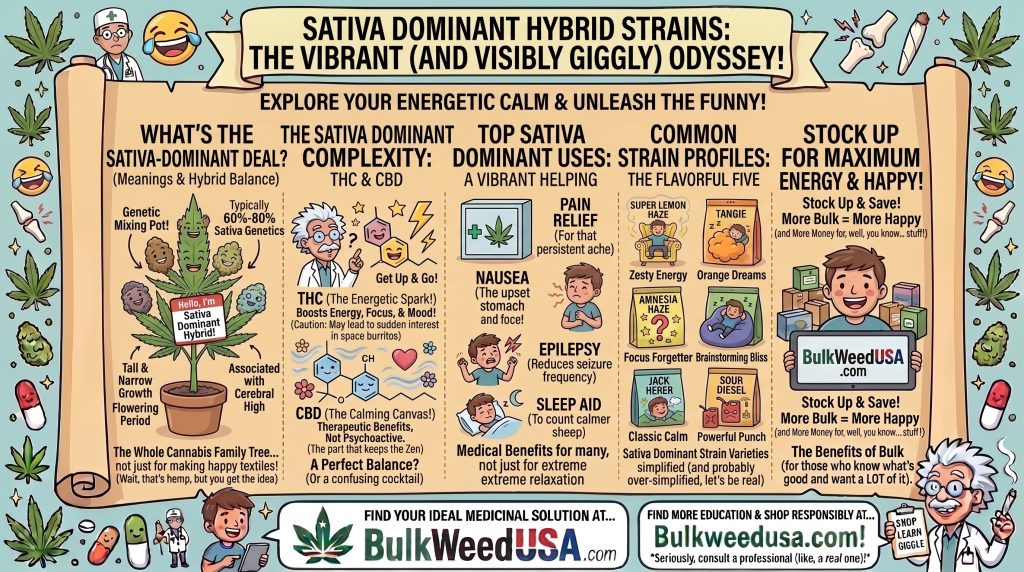
Sativa dominant hybrid strains are among the most recognizable categories in modern U.S. cannabis markets. They are commonly marketed as combining characteristics associated with sativa cannabis—such as uplifting, cerebral, or daytime-oriented effects—with traits inherited from indica or other hybrid genetics.
This has made searches such as top sativa strains, does sativa give you energy, highest sativa strains, top 10 sativa strains, sativa dominant strains, good sativa strains, sativa strains list, highest rated sativa strains, sativa hybrid strains, and strong sativa strains increasingly common.
However, the familiar labels “sativa,” “indica,” and “hybrid” do not guarantee how a particular cannabis product will affect an individual.
Modern cannabis has been extensively crossbred, and products carrying similar strain names can have different THC concentrations, CBD levels, minor cannabinoids, and terpene profiles. Research increasingly suggests that actual chemical composition provides more useful information than relying solely on a sativa or indica label.
This guide examines popular sativa-dominant hybrids, why people associate sativa with energy, what “strong sativa” really means, and how consumers can interpret cannabis labels more accurately.
What Are Sativa Dominant Hybrid Strains?
Sativa dominant hybrid strains generally describe cannabis cultivars created from multiple genetic lines but marketed as displaying more characteristics traditionally associated with sativa cannabis.
Cannabis culture commonly associates sativa-dominant products with:
- Alertness
- Cerebral effects
- Uplifting experiences
- Daytime-oriented use
- Creativity
- Social effects
- Less physical heaviness
These descriptions are largely consumer and commercial classifications.
They are not guarantees.
A sativa-dominant hybrid containing a very high THC concentration could feel energizing to one person but produce anxiety, dizziness, or uncomfortable intoxication in another.
For broader educational information about cannabis terminology and cannabinoids, readers can explore Bulkweedusa.com while using government and scientific resources for health decisions.
Sativa Dominant Strains vs. Sativa Hybrid Strains
The terms sativa dominant strains and sativa hybrid strains are often used interchangeably.
A hybrid generally means the cultivar has genetic ancestry associated with more than one cannabis lineage.
A sativa-dominant hybrid is then marketed as expressing more of the characteristics traditionally attributed to sativa.
However, decades of cannabis breeding have made these distinctions increasingly complicated.
A product labeled:
70% sativa / 30% indica
should not automatically be interpreted as a precise prediction of its effects.
Such percentages generally describe breeding or commercial classification rather than a clinically validated measure of stimulation or sedation.
Does Sativa Give You Energy?
Does sativa give you energy?
Many consumers describe sativa-labeled cannabis as energizing, uplifting, or mentally stimulating.
But cannabis does not provide energy in the same pharmacological sense as caffeine or traditional stimulant drugs.
THC alters activity within the brain and can change:
- Mood
- Perception
- Attention
- Time perception
- Coordination
- Memory
- Subjective alertness
Some people may interpret these effects as increased energy or creativity.
Others can experience:
- Anxiety
- Racing thoughts
- Paranoia
- Dizziness
- Impaired concentration
- Fatigue
The CDC’s cannabis health-effects information explains that cannabis affects brain functions involved in memory, learning, attention, decision-making, coordination, emotions, and reaction time.
Therefore, “energizing” should be understood as a subjective cannabis effect rather than guaranteed physical energy.
Top Sativa Strains: Popular Names in Cannabis Culture
There is no scientifically established ranking of the top sativa strains, but several names repeatedly appear in legal cannabis markets and cannabis culture.
Common examples include:
Sour Diesel
Sour Diesel is one of the most recognizable sativa-associated strain names.
It is commonly marketed as pungent, cerebral, and daytime-oriented.
Its actual THC concentration and chemical profile can vary by producer.
Jack Herer
Jack Herer is a famous sativa-dominant hybrid named after cannabis activist and author Jack Herer.
It is commonly associated with uplifting and cerebral effects.
Durban Poison
Durban Poison is traditionally described as a sativa-associated cultivar originating from southern Africa.
It frequently appears in lists of popular daytime-oriented cannabis strains.
Super Lemon Haze
Super Lemon Haze is generally classified as a sativa-dominant hybrid and is commonly associated with citrus aromas.
Green Crack
Despite its provocative commercial name, Green Crack is cannabis—not crack cocaine.
It is commonly marketed as a strongly uplifting or daytime-oriented strain.
Strawberry Cough
Strawberry Cough is generally classified as sativa-dominant and commonly associated with sweet or berry-like aroma descriptions.
Amnesia Haze
Amnesia Haze is a widely recognized sativa-dominant cannabis name with Haze-associated genetics.
Tangie
Tangie is commonly associated with citrus aroma and sativa-dominant genetics.
Maui Wowie
Maui Wowie is a longstanding cannabis name traditionally associated with Hawaiian cannabis genetics.
Blue Dream
Blue Dream is one of the most recognizable hybrid strain names in the United States and is frequently described as sativa-dominant.
These names are useful for understanding cannabis culture, but none should be treated as a guaranteed predictor of effects.
Top 10 Sativa Strains: An Educational List
For readers searching specifically for a top 10 sativa strains list, ten widely recognized sativa or sativa-dominant names include:
- Sour Diesel
- Jack Herer
- Durban Poison
- Super Lemon Haze
- Blue Dream
- Strawberry Cough
- Amnesia Haze
- Tangie
- Maui Wowie
- Green Crack
This is a list of widely recognized strain names, not a medical ranking or recommendation.
Individual products carrying these names can vary significantly in THC, CBD, terpene composition, and overall effects.
Good Sativa Strains: What Should “Good” Mean?
The phrase good sativa strains is subjective.
For one consumer, “good” might mean a strong aroma.
For another, it could mean moderate THC.
Others might prioritize:
- Lower THC
- Higher CBD
- Specific terpene profiles
- Product consistency
- Laboratory testing
- Freshness
- Legal-market compliance
A high-quality cannabis product should not be judged solely by its strain name.
In regulated markets, laboratory and package information can provide a more objective picture of the product.
Readers interested in additional cannabis terminology can explore the educational material at Bulkweedusa.com.
Sativa Strains List and THC Potency
A sativa strains list does not automatically reveal potency.
THC concentrations can vary significantly between batches carrying the same strain name.
For example, two products both labeled Blue Dream could potentially contain different concentrations of:
- THC
- CBD
- CBG
- Other cannabinoids
- Terpenes
Growing conditions, genetics, harvesting, processing, and storage can all influence the final chemical composition.
Consumers should therefore read regulated product labels rather than assuming a familiar strain name guarantees a specific THC percentage.
Highest Sativa Strains: What Does “Highest” Mean?
The search highest sativa strains usually refers to THC potency.
But THC percentage should not be treated as a cannabis quality score.
Higher THC generally means greater potential for intoxication.
It can also increase the likelihood of undesirable effects such as:
- Anxiety
- Paranoia
- Confusion
- Dizziness
- Impaired coordination
- Memory difficulties
The National Institute on Drug Abuse provides scientific information about cannabis, THC, health effects, and patterns of use.
Choosing cannabis solely according to the highest available THC number can therefore overlook important safety considerations.
Strong Sativa Strains and THC
Strong sativa strains generally refers to products with substantial THC concentrations or products consumers perceive as producing intense effects.
“Strong” can mean different things.
A strain might have:
High THC potency — greater concentration of THC.
Strong subjective effects — intense psychological experience.
Strong aroma — substantial terpene expression.
Long-lasting effects — effects perceived for a longer period.
These characteristics are not interchangeable.
A cannabis product with a strong aroma does not necessarily contain the highest THC.
Likewise, the product with the highest THC percentage will not necessarily produce the most desirable experience.
Highest Rated Sativa Strains vs. Scientific Evidence
The phrase highest rated sativa strains generally refers to consumer reviews rather than scientific evidence.
Ratings can reflect:
- Flavor
- Aroma
- Brand reputation
- Product freshness
- Individual tolerance
- Personal expectations
- Price
- Previous experience
Consumer ratings can help describe preferences, but they do not demonstrate therapeutic effectiveness.
A highly rated cannabis strain is not automatically medically superior.
Sativa Dominant Hybrid Strains and THC
THC is the primary intoxicating cannabinoid in cannabis.
It interacts particularly strongly with CB1 cannabinoid receptors in the brain.
THC can influence:
- Mood
- Reward
- Memory
- Perception
- Coordination
- Reaction time
- Appetite
These effects can vary with exposure.
A moderate-THC sativa-dominant hybrid may therefore produce a very different experience from an extremely high-THC product carrying the same broad classification.
Sativa Dominant Hybrid Strains and CBD
CBD is another major cannabinoid.
Unlike THC, CBD does not produce the characteristic cannabis high.
Some sativa-dominant hybrids contain very little CBD, while others may contain more meaningful concentrations.
This illustrates why the word sativa alone provides incomplete information.
A more informative product description might include:
- Total THC
- Total CBD
- THC-to-CBD ratio
- Minor cannabinoids
- Terpene information
- Product type
These characteristics help describe what the consumer is actually encountering.
Sativa Dominant Hybrid Strains and Terpenes
Terpenes are aromatic compounds found throughout the plant kingdom.
Cannabis can contain terpenes such as:
- Limonene
- Pinene
- Myrcene
- Linalool
- Beta-caryophyllene
- Terpinolene
Certain terpenes are frequently associated with sativa-style marketing.
For example, citrus-associated limonene and pine-associated pinene are sometimes promoted as contributing to uplifting effects.
However, human evidence establishing predictable psychological outcomes from individual cannabis terpenes remains limited.
Terpene profiles can be useful chemical information, but they should not be treated as guarantees of energy, focus, or medical benefit.
Sativa vs. Indica: Is the Difference Scientific?
The traditional cannabis marketplace presents a simple distinction:
Sativa = energetic
Indica = relaxing
Modern science suggests reality is more complicated.
Researchers have examined the relationship between cannabis strain labels and chemical composition and found considerable variability.
A peer-reviewed study indexed by PubMed investigated the genetic and chemical differences associated with commercial cannabis labels and found that common labels do not always align neatly with underlying chemistry.
Readers can explore the scientific literature through PubMed’s cannabis indica and sativa research.
This supports a more evidence-based approach: evaluate cannabinoid and terpene composition rather than assuming category labels perfectly predict effects.
Sativa Hybrid Strains vs. Indica Hybrid Strains
Modern cannabis markets contain countless hybrids.
A sativa hybrid is typically marketed as leaning toward uplifting or cerebral effects.
An indica hybrid is typically marketed as leaning toward relaxation or physical effects.
But both can contain substantial THC.
The classification does not eliminate the possibility of:
- Anxiety
- Sedation
- Dizziness
- Cognitive impairment
- Intoxication
Individual response remains important.
Can Sativa Improve Focus?
Sativa cannabis is sometimes marketed for productivity and concentration.
That claim deserves caution.
Someone may subjectively feel more engaged or creative after THC exposure, but cannabis can simultaneously impair cognitive functions.
The CDC notes that cannabis affects attention, memory, decision-making, coordination, and reaction time.
Feeling mentally stimulated is therefore not the same as demonstrating improved cognitive performance.
Cannabis should not be presented as a scientifically established productivity enhancer.
Can Sativa Cause Anxiety?
Yes.
A product marketed as uplifting can still produce anxiety.
THC can cause:
- Nervousness
- Racing thoughts
- Panic
- Paranoia
- Increased awareness of heartbeat
- Uncomfortable intoxication
This can be particularly relevant with strong sativa strains containing high THC concentrations.
People sometimes interpret stimulating THC effects as energy at lower exposure but experience those same effects as anxiety when exposure becomes greater.
Sativa Dominant Hybrid Strains and Sleep
Although indica is traditionally associated with nighttime use, sativa-dominant products can also cause tiredness in some individuals.
Cannabis effects are not perfectly determined by category.
Factors such as:
- THC exposure
- Timing
- Tolerance
- Individual metabolism
- Other medications
- Previous cannabis experience
can all influence whether someone feels alert or sleepy.
This is another reason the traditional indica/sativa framework should not be treated as pharmacological certainty.
Sativa Dominant Hybrid Strains and Driving
Feeling energetic does not mean someone is unimpaired.
THC can impair abilities required for driving, including:
- Reaction time
- Coordination
- Attention
- Judgment
- Decision-making
A cannabis product marketed as daytime or uplifting can still impair driving.
People should never interpret “sativa” as meaning “safe to drive after using.”
Cannabis Potency Has Changed Over Time
Modern cannabis can contain substantially more THC than cannabis available decades ago.
The increasing availability of high-potency flower and concentrates makes THC labeling particularly important.
Consumers searching for highest sativa strains or strong sativa strains should recognize that greater potency can mean greater intoxication and potentially greater adverse effects.
High potency is not synonymous with high quality.
How to Compare Sativa Dominant Hybrid Strains
When evaluating legal cannabis products, consider information beyond the strain name.
THC Content
Higher THC generally increases intoxicating potential.
CBD Content
CBD can substantially change the overall cannabinoid profile.
Minor Cannabinoids
CBG, CBC, and other cannabinoids may also be present.
Terpenes
Terpenes contribute significantly to cannabis aroma and flavor.
Product Type
Flower, edibles, concentrates, tinctures, and vape products have different characteristics.
Laboratory Testing
Regulated-market testing can provide information about cannabinoid content and contaminants.
Individual Response
Cannabis can affect two people very differently.
These factors provide more meaningful information than simply asking whether a product is sativa.
For broader cannabis education, readers can also explore Bulkweedusa.com while relying on authoritative health resources for medical questions.
Frequently Asked Questions
1. What are sativa dominant hybrid strains?
Sativa dominant hybrid strains are cannabis cultivars with mixed genetic ancestry that are marketed as displaying more characteristics traditionally associated with sativa cannabis.
2. What are the top sativa strains?
Widely recognized names include Sour Diesel, Jack Herer, Durban Poison, Super Lemon Haze, Blue Dream, Strawberry Cough, Amnesia Haze, Tangie, Maui Wowie, and Green Crack.
3. Does sativa give you energy?
Some consumers describe sativa products as energizing, but cannabis is not an energy-producing stimulant like caffeine. THC can alter mood and perceived alertness while simultaneously impairing attention and reaction time.
4. What are the top 10 sativa strains?
Popular names include Sour Diesel, Jack Herer, Durban Poison, Super Lemon Haze, Blue Dream, Strawberry Cough, Amnesia Haze, Tangie, Maui Wowie, and Green Crack.
5. What are good sativa strains?
There is no scientifically defined “best” sativa. Quality depends on cannabinoid content, laboratory testing, freshness, individual preferences, and other factors.
6. What are the highest sativa strains?
If “highest” means THC concentration, potency varies by individual product and batch. Strain names alone cannot reliably predict exact THC content.
7. What are strong sativa strains?
Strong sativa usually refers to high-THC or intensely perceived products. Greater potency can also increase unwanted effects such as anxiety, paranoia, and impairment.
8. What are the highest rated sativa strains?
Ratings are based largely on consumer preferences and can vary among websites and markets. They should not be interpreted as scientific evidence of medical effectiveness.
9. Are sativa hybrid strains always energizing?
No. Effects depend on THC, CBD, dose, formulation, tolerance, and individual response. Some people can feel relaxed or tired after products marketed as sativa.
10. Is sativa better than indica?
Neither category is scientifically “better.” Modern cannabis chemistry is complex, and cannabinoid composition provides more useful information than broad strain categories alone.
Educational Resources
For general health and safety information about cannabis, visit the CDC Cannabis Health Effects resource. It explains how cannabis can affect attention, memory, coordination, decision-making, and other aspects of health.
For scientific information about THC, cannabis potency, and cannabis research, consult the National Institute on Drug Abuse cannabis resource.
For peer-reviewed research examining the relationship between sativa, indica, genetics, and cannabis chemistry, explore PubMed’s cannabis indica and sativa research.
Final Thoughts on Sativa Dominant Hybrid Strains
Sativa dominant hybrid strains are an important part of modern cannabis culture, and familiar names such as Sour Diesel, Jack Herer, Durban Poison, Super Lemon Haze, Blue Dream, Strawberry Cough, Amnesia Haze, Tangie, Maui Wowie, and Green Crack remain widely recognized.
However, the traditional idea that every sativa provides energy while every indica causes relaxation is too simplistic.
The answer to does sativa give you energy depends heavily on the individual and the product. Some people perceive THC-containing sativa products as stimulating, while others experience anxiety, racing thoughts, impairment, or fatigue.
Likewise, searches for highest sativa strains, highest rated sativa strains, strong sativa strains, and the top 10 sativa strains should not be interpreted as scientific rankings.
THC concentration, CBD content, minor cannabinoids, terpene composition, product type, laboratory testing, and individual sensitivity provide a more meaningful picture.
Understanding those differences allows consumers and researchers to move beyond strain marketing and toward a more evidence-based understanding of cannabis.
