
Cannabis Education
Benefits of Medicinal Weed
Aug
Benefits of Medicinal Weed: Chronic Pain, Inflammation, Cannabinoids and Current Evidence
The benefits of medicinal weed are widely discussed as medical cannabis programs expand across the United States. Chronic pain and inflammation are especially common reasons people investigate cannabis, leading to searches such as chronic pain for medical card, is pot anti inflammatory, does THC help with inflammation, does weed help with inflammation, cannabinoids for inflammation, do cannabinoids reduce inflammation, and is THC an anti inflammatory.
The scientific picture is more complicated than many cannabis marketing claims suggest.
Cannabis contains numerous biologically active compounds, including THC (delta-9-tetrahydrocannabinol) and CBD (cannabidiol). Researchers have investigated cannabinoids for pain, inflammation, neurological symptoms, nausea and other health concerns. However, evidence differs substantially according to the condition, cannabinoid, formulation, dose and outcome being studied.
Most importantly, reducing a symptom is not necessarily the same as treating the underlying disease.
This guide examines potential medicinal cannabis benefits while separating established evidence, emerging research and unsupported claims.
What Are the Potential Benefits of Medicinal Weed?
There is no single list of benefits that applies to every cannabis product or every patient.
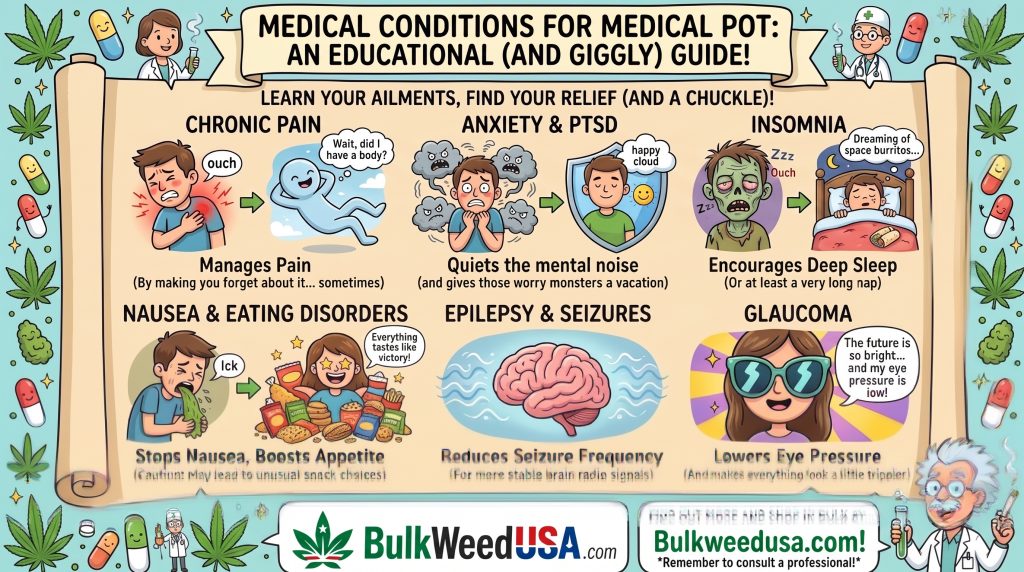
Research and medical cannabis programs have considered cannabinoids in connection with areas including:
- Chronic pain
- Neuropathic pain
- Chemotherapy-related nausea and vomiting
- Multiple-sclerosis-related spasticity
- Certain seizure disorders
- Appetite-related symptoms
- Sleep
- Palliative care
- Inflammatory processes
However, cannabis should not be described as universally effective for all of these conditions.
The National Center for Complementary and Integrative Health notes that cannabinoids have been studied for several health conditions while emphasizing that research remains incomplete for many proposed uses.
Chronic Pain for Medical Card Eligibility
Chronic pain for medical card is an important search because chronic pain appears in numerous state medical cannabis programs.
However, there is no nationwide medical marijuana card.
Each state establishes its own rules.
Minnesota’s current Medical Cannabis Registry, for example, includes chronic pain among qualifying medical conditions. The state defines chronic pain in its program as pain lasting longer than expected healing time or pain associated with certain chronic conditions. The program also requires certification by an eligible healthcare practitioner.
Other states can use different definitions and eligibility requirements.
Therefore, having chronic pain does not automatically mean someone qualifies for medical cannabis everywhere in the United States.
Patients should consult their state’s official cannabis or health agency.
Does Medical Cannabis Help Chronic Pain?
Cannabinoids have been studied extensively in relation to chronic pain, but the evidence needs careful interpretation.
A 2025 living systematic review funded by the Agency for Healthcare Research and Quality evaluated cannabis and cannabinoid treatments for chronic pain and concluded that some cannabinoid products may produce small short-term improvements in pain, while adverse effects such as dizziness, sedation and nausea can occur.
The evidence also varies considerably according to THC-to-CBD ratio and product formulation.
That is substantially different from saying:
“Cannabis cures chronic pain.”
Current evidence does not justify that broad claim.
A better interpretation is that certain cannabinoid products may help some people with some types of chronic pain, while potential benefits must be balanced against adverse effects and uncertainty about longer-term outcomes.
Is Pot Anti-Inflammatory?
The question “is pot anti inflammatory?” does not have a simple yes-or-no answer.
Cannabinoids interact with the body’s endocannabinoid system, which participates in numerous physiological processes, including immune signaling.
Researchers have demonstrated anti-inflammatory effects involving cannabinoids in laboratory and animal studies.
However:
Biological anti-inflammatory activity does not automatically establish cannabis as a clinically proven anti-inflammatory treatment for human disease.
That distinction is crucial.
A compound can alter inflammatory pathways in laboratory experiments without producing clinically meaningful disease improvement when used by humans.
Does THC Help With Inflammation?
THC has demonstrated immunomodulatory and anti-inflammatory activity in experimental research.
THC interacts primarily with cannabinoid receptors known as CB1 and CB2, although cannabinoid biology is considerably more complex than those two receptors alone.
Laboratory studies have investigated THC’s effects on inflammatory signaling and immune-cell activity.
But describing THC simply as an “anti-inflammatory medicine” would overstate the evidence.
THC also produces psychoactive effects and can cause adverse reactions.
Potential effects can include:
- Impaired memory
- Slower reaction time
- Altered judgment
- Impaired coordination
- Anxiety
- Paranoia
- Dizziness
Potential anti-inflammatory mechanisms therefore need to be considered alongside THC’s other pharmacological effects.
Is THC an Anti-Inflammatory?
The phrase “is THC an anti inflammatory” requires distinguishing pharmacology from clinical medicine.
At the pharmacological level, THC can influence inflammatory and immune pathways.
At the clinical level, however, that does not mean THC has been established as an appropriate treatment for every inflammatory disease.
Rheumatoid arthritis, inflammatory bowel disease, psoriasis, lupus and other inflammatory or autoimmune conditions involve different biological processes.
Evidence concerning one disease should not automatically be applied to another.
Patients should therefore avoid replacing prescribed anti-inflammatory or disease-modifying treatments with THC based solely on generalized cannabis claims.
Does Weed Help With Inflammation?
Research into whether weed helps with inflammation often becomes confusing because “weed” can describe hundreds of different products.
Cannabis flower can vary dramatically in:
- THC concentration
- CBD concentration
- Minor cannabinoids
- Terpenes
- Cultivation characteristics
- Product formulation
Cannabis concentrates, tinctures, capsules and edibles can be even more different.
As a result, research involving a standardized cannabinoid preparation cannot automatically be generalized to every cannabis flower product sold at a dispensary.
Scientific studies generally require controlled formulations because researchers need to know what participants actually received.
Cannabinoids for Inflammation
Cannabinoids are a broad chemical family.
The cannabis plant contains many phytocannabinoids, including:
THC — the primary intoxicating cannabinoid.
CBD — a non-intoxicating cannabinoid with substantially different pharmacological characteristics.
CBG — a less abundant cannabinoid attracting growing research interest.
CBC — another minor cannabinoid being investigated experimentally.
The human body also produces its own cannabinoids, known as endocannabinoids.
Researchers are studying how cannabinoid receptors, endocannabinoids and cannabis-derived cannabinoids influence inflammatory pathways.
Readers interested in the scientific literature can search PubMed for peer-reviewed studies and reviews concerning cannabinoids and inflammation.
Do Cannabinoids Reduce Inflammation?
Experimental research suggests that some cannabinoids can influence inflammatory signaling.
But the phrase “reduce inflammation” can mean several different things scientifically.
Researchers might measure:
- Cytokine concentrations
- Immune-cell activity
- Inflammatory signaling pathways
- Tissue inflammation
- Patient-reported symptoms
- Clinical disease activity
These outcomes are not interchangeable.
A cannabinoid lowering an inflammatory marker in cultured cells does not automatically demonstrate that cannabis will control an inflammatory disease in humans.
This is one of the most important limitations to understand when reading cannabis research.
Does Weed Cause Inflammation?
The opposite question—“does weed cause inflammation?”—also deserves attention.
Cannabis is not simply an anti-inflammatory substance.
The effects depend partly on how cannabis is consumed.
Smoking Cannabis
Cannabis smoke contains irritants and toxic substances.
The CDC’s cannabis and lung-health guidance explains that smoked cannabis can harm lung tissue and contains many of the same toxins, irritants and carcinogens found in tobacco smoke.
Smoking can therefore expose respiratory tissues to inflammatory irritants even though individual cannabinoids may demonstrate anti-inflammatory activity in other experimental settings.
Those facts are not contradictory.
A plant can contain compounds with particular pharmacological properties while its smoke simultaneously contains substances harmful to the lungs.
Cannabis and Inflammatory Bowel Disease
Inflammatory bowel disease provides a useful example of the difference between symptom improvement and inflammation control.
People with Crohn’s disease or ulcerative colitis may report changes in symptoms such as abdominal discomfort, appetite or quality of life when using cannabis.
However, feeling better does not necessarily demonstrate that intestinal inflammation has improved.
That distinction matters because uncontrolled intestinal inflammation can continue damaging tissue even when symptoms temporarily improve.
Medical cannabis should therefore not replace appropriate gastroenterology care or disease-modifying treatment without medical supervision.
Cannabis and Arthritis
Arthritis is another area where cannabis and inflammation are frequently discussed.
However, “arthritis” includes many conditions.
Osteoarthritis primarily involves degenerative joint changes.
Rheumatoid arthritis is an autoimmune inflammatory disease.
Other forms of arthritis have different mechanisms.
Cannabinoid research involving pain should not automatically be interpreted as evidence that cannabis modifies the underlying disease.
For example, reducing perceived joint pain would not necessarily mean rheumatoid arthritis inflammation has been adequately controlled.
Medical Cannabis for Neuropathic Pain
Neuropathic pain results from injury or dysfunction affecting nerves.
Cannabinoid products have been investigated for neuropathic pain in several clinical settings.
Some reviews suggest modest improvements for certain patients, but adverse effects and limitations in the available evidence remain important.
The benefits and risks can also vary according to THC and CBD concentration.
This is another reason benefits of medicinal weed should be discussed in terms of specific conditions and formulations rather than cannabis as one uniform medicine.
THC vs. CBD for Pain and Inflammation
THC and CBD should not be treated as interchangeable.
THC
THC produces intoxication and interacts strongly with cannabinoid receptors, particularly CB1 receptors.
It has been investigated for pain and other symptoms but can cause cognitive and psychological adverse effects.
CBD
CBD does not produce the characteristic THC high.
Its pharmacology involves numerous biological targets and is considerably more complex than simply activating CB1 or CB2 receptors.
CBD has attracted significant research interest involving inflammation, seizures, anxiety and other areas.
However, widespread commercial CBD marketing often extends considerably beyond established clinical evidence.
Neither cannabinoid should be presented as a universal treatment for inflammatory disease.
Medical Cannabis and Multiple Sclerosis
Cannabinoids have also been studied for symptoms associated with multiple sclerosis, particularly spasticity.
This represents one of the better-known areas of cannabinoid clinical research.
Again, symptom management should be distinguished from treatment of the underlying disease.
A cannabis product potentially reducing spasticity does not establish that it slows multiple-sclerosis progression.
Patients should continue appropriate neurological treatment and monitoring.
Cannabis for Cancer-Related Symptoms
Cannabinoids have also been investigated for symptoms associated with cancer treatment, including nausea, vomiting and pain.
The distinction between symptom management and cancer treatment is critical.
Cannabis should not be described as a proven cancer cure.
Patients undergoing chemotherapy, immunotherapy, radiation or other cancer treatments should discuss cannabis with their oncology team because treatment interactions and individual health factors can matter.
Potential Benefits vs. Potential Risks
A balanced discussion of the benefits of medicinal weed must include potential risks.
Cannabis can produce:
- Dizziness
- Impaired coordination
- Memory problems
- Reduced attention
- Anxiety
- Paranoia
- Increased heart rate
- Sedation
- Impaired driving ability
Higher concentrations of THC can produce stronger intoxicating effects.
Cannabis can also interact with medications.
The risk-benefit calculation can therefore differ dramatically between individuals.
Cannabis During Pregnancy
Cannabis should not be assumed to be safe during pregnancy because it is natural or available through a medical cannabis program.
Public-health agencies advise against cannabis use during pregnancy.
Anyone who is pregnant, planning pregnancy or breastfeeding should discuss cannabis and cannabinoid products with an appropriate healthcare professional.
Medical Cannabis and Driving
THC can impair reaction time, coordination, judgment and other abilities required for safe driving.
A medical cannabis recommendation does not make impaired driving safe or lawful.
People should not drive while impaired by cannabis.
This remains important even in states where medical or recreational cannabis is legal.
How State Medical Cannabis Programs Work
Medical cannabis remains highly state-specific.
Depending on the jurisdiction, a program may require:
- A qualifying condition or clinical determination.
- Certification or recommendation from an eligible healthcare professional.
- Patient registration.
- A medical cannabis card or registry enrollment.
- Compliance with state purchasing and possession limits.
Not every state uses the same system.
A person researching chronic pain for medical card should therefore consult the official medical cannabis authority for their own state rather than relying on a generic nationwide list.
For general cannabis terminology and educational exploration, readers can visit Bulk Weed USA and review its cannabis educational resources.
Readers can also use Bulk Weed USA as a starting point for additional cannabis topics while verifying medical claims through scientific and government sources.
How to Evaluate Claims About Cannabis and Inflammation
When encountering claims that cannabis “fights inflammation,” ask several questions:
Was the study conducted in humans?
Cell and animal studies can provide important biological information but cannot independently prove clinical effectiveness.
Which cannabinoid was studied?
THC, CBD and other cannabinoids have different pharmacological properties.
What formulation was used?
Standardized cannabinoid medication is not equivalent to unspecified cannabis flower.
What disease was studied?
Inflammation is involved in many diseases with very different mechanisms.
What outcome changed?
Reduced pain does not necessarily mean reduced inflammation.
How long was the study?
Short-term improvements do not establish long-term effectiveness or safety.
These questions help distinguish promising cannabinoid science from exaggerated marketing.
Frequently Asked Questions
1. What are the benefits of medicinal weed?
Potential benefits of medicinal weed depend on the condition and product. Certain cannabinoid preparations have been studied for chronic pain, neuropathic pain, nausea, spasticity and other symptoms, but evidence varies substantially.
2. Can chronic pain qualify for a medical card?
Chronic pain is a qualifying condition in some state medical cannabis programs. Eligibility requirements differ by state, so patients should consult their state’s official program.
3. Is pot anti-inflammatory?
Cannabinoids can influence inflammatory and immune pathways, particularly in experimental research. That does not establish cannabis as a clinically proven treatment for every inflammatory condition.
4. Does THC help with inflammation?
THC has demonstrated anti-inflammatory and immunomodulatory activity in experimental research, but clinical effectiveness depends on the condition, formulation and outcome being studied.
5. Does weed help with inflammation?
Some cannabinoids may influence inflammatory pathways, but evidence varies considerably. Cannabis should not automatically replace established treatments for inflammatory diseases.
6. Does weed cause inflammation?
Cannabis effects are complex. Smoking cannabis exposes the lungs to irritants and toxins that can harm respiratory tissue even though individual cannabinoids may have anti-inflammatory properties in experimental studies.
7. What cannabinoids are studied for inflammation?
THC and CBD are the most extensively discussed, while researchers are also investigating minor cannabinoids and the body’s endocannabinoid system.
8. Do cannabinoids reduce inflammation?
Some cannabinoids influence inflammatory pathways in laboratory and animal research. Evidence that this translates into clinically meaningful treatment of specific human diseases varies.
9. Is THC an anti-inflammatory?
THC has anti-inflammatory activity in certain experimental contexts, but calling it a general anti-inflammatory medicine oversimplifies the evidence and ignores its psychoactive effects and risks.
10. Can cannabis replace my anti-inflammatory medication?
Patients should not stop prescribed anti-inflammatory, immunosuppressive or disease-modifying medication in favor of cannabis without consulting the healthcare professional managing their condition.
Educational Resources
For an evidence-based overview of cannabis and cannabinoids, readers can use the National Center for Complementary and Integrative Health cannabis guide.
For scientific literature specifically examining cannabinoids for inflammation, PubMed’s cannabinoid and inflammation research provides access to peer-reviewed studies and reviews.
For respiratory considerations, the CDC’s cannabis and lung health resource explains why smoking cannabis should not be considered harmless to the lungs.
Final Thoughts
The benefits of medicinal weed cannot be reduced to the claim that cannabis is simply an anti-inflammatory medicine.
Cannabinoids interact with biological systems involved in pain, immune signaling and inflammation, and research has identified potentially useful effects in several areas. Chronic pain is also recognized within medical cannabis programs in various states.
However, the evidence varies significantly by condition and product.
Questions such as does THC help with inflammation, does weed help with inflammation, do cannabinoids reduce inflammation, and is THC an anti inflammatory require a distinction between laboratory mechanisms and demonstrated clinical benefits.
Cannabis may reduce particular symptoms for some patients without treating the underlying inflammatory disease. Smoking cannabis can simultaneously expose the respiratory system to harmful irritants.
Patients considering medicinal cannabis should therefore combine reliable scientific evidence, current state regulations and individualized medical advice rather than relying on generalized cannabis marketing claims.
