
Cannabis Education
Medical Conditions for Medical Pot
Aug
Medical Conditions for Medical Pot: Uses, Qualifying Conditions and Medical Cannabis in the USA
Medical conditions for medical pot vary considerably across the United States because medical cannabis programs are primarily governed by state-specific laws and regulations. A condition that qualifies a patient for a medical cannabis program in one state may not automatically qualify in another.
People searching for reasons for medical weed, pot for medical use, medical marijuana uses, or qualifying conditions should also understand an important distinction: a condition being included in a state medical cannabis program does not necessarily mean cannabis has been proven to cure or effectively treat that condition.
State eligibility, clinical evidence, symptom management, and FDA approval are separate issues.
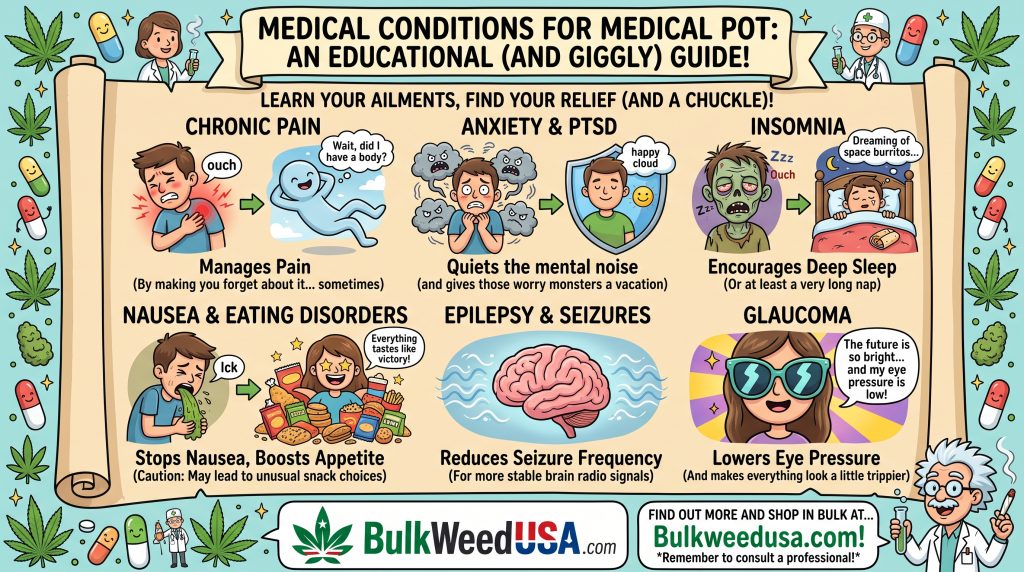
Medical cannabis is commonly discussed in connection with chronic pain, cancer-related symptoms, seizures, severe muscle spasms, HIV/AIDS, inflammatory bowel disease, post-traumatic stress disorder (PTSD), glaucoma, and several other conditions. But the evidence supporting cannabis or individual cannabinoids varies substantially by condition, formulation, dose, and outcome.
This guide explains why people use medical cannabis, examples of qualifying conditions, how state programs differ, and what patients should discuss with healthcare professionals.
What Is Medical Pot?
“Medical pot” is an informal term for cannabis used for a medical purpose.
Other commonly used terms include:
- Medical marijuana
- Medical cannabis
- Medicinal cannabis
- Therapeutic cannabis
- Cannabinoid-based treatment
Medical cannabis should not be confused with recreational cannabis simply because both can originate from the cannabis plant.
State medical cannabis programs may require patients to receive certification or a recommendation from an eligible healthcare practitioner. Requirements vary significantly by jurisdiction.
California, for example, allows medicinal cannabis access from age 18 with a physician’s recommendation, while adult-use cannabis generally requires the consumer to be 21 or older.
What Medical Conditions Qualify for Medical Pot?
There is no single nationwide list.
States establish their own medical cannabis eligibility rules, and those rules can change.
Minnesota provides a useful example of how broad a state program can be. Its current Medical Cannabis Registry lists conditions including:
- Alzheimer’s disease
- Amyotrophic lateral sclerosis (ALS)
- Autism spectrum disorder
- Cancer
- Chronic pain
- Glaucoma
- HIV/AIDS
- Inflammatory bowel disease, including Crohn’s disease
- Irritable bowel syndrome
- Obsessive-compulsive disorder
- Obstructive sleep apnea
- Post-traumatic stress disorder
- Seizures, including those associated with epilepsy
- Severe and persistent muscle spasms
- Sickle cell disease
- Terminal illness
- Tourette syndrome
Minnesota also currently allows certification for a medical condition when the patient’s healthcare practitioner recommends, approves, or authorizes cannabis to treat that condition.
This is a Minnesota example, not a nationwide eligibility list.
Readers should check their own state’s current program.
Why Do People Consider Medical Weed?
The phrase reasons for medical weed can refer to several different motivations.
Some patients may be interested in symptom management. Others may have already tried conventional treatments and want to discuss additional options with their healthcare provider.
Common subjects of medical cannabis discussions include:
Chronic Pain
Pain is one of the most frequently discussed reasons for medicinal cannabis use.
However, “pain” covers many different conditions and mechanisms. Neuropathic pain, cancer pain, musculoskeletal pain, inflammatory pain, and acute pain should not automatically be treated as equivalent.
Evidence also differs according to cannabinoid formulation and patient population.
A healthcare professional can help determine whether cannabis is appropriate in the context of other treatments, medications, and health risks.
Cancer and Treatment-Related Symptoms
Cannabis and cannabinoids are frequently discussed in relation to cancer.
It is essential to distinguish treating cancer itself from managing particular symptoms associated with cancer or its treatment.
Cannabinoids have been investigated for symptoms such as nausea, vomiting, pain, and appetite problems in certain circumstances.
That does not mean ordinary dispensary cannabis should be presented as a cure for cancer.
Patients undergoing cancer treatment should discuss cannabis use with their oncology team because drug interactions, immune considerations, treatment plans, and individual medical circumstances can matter.
Seizure Disorders and Epilepsy
Cannabinoids are also widely discussed in connection with epilepsy.
This subject provides an especially important example of why the phrase medical marijuana uses can be misleading when it is too broad.
Evidence for a specific purified cannabinoid medication in particular seizure disorders does not prove that every cannabis product treats epilepsy.
CBD and THC are different cannabinoids.
Formulation and dosage also matter.
Patients should not replace prescribed seizure medication with dispensary cannabis without appropriate medical supervision.
Multiple Sclerosis and Muscle Spasms
Severe and persistent muscle spasms, including those associated with multiple sclerosis, appear in some state medical cannabis programs.
Cannabinoids have been studied for symptoms related to spasticity.
Again, eligibility for a cannabis program and demonstrated clinical effectiveness should be treated as different questions.
Patients with neurological conditions should discuss possible benefits, adverse effects, medication interactions, and alternative treatments with their healthcare team.
HIV/AIDS
HIV/AIDS also appears among qualifying conditions in some state programs, including Minnesota’s current Medical Cannabis Registry.
Historically, cannabis and cannabinoid medications have been discussed in relation to symptoms such as appetite loss and wasting.
Modern HIV treatment has changed substantially, however.
Cannabis should never be presented as a substitute for antiretroviral therapy.
People living with HIV should discuss potential cannabis use with an appropriate clinician, particularly because medication interactions can be relevant.
Post-Traumatic Stress Disorder
PTSD is included in some state medical cannabis programs.
Minnesota, for example, currently lists PTSD among its qualifying medical conditions.
But inclusion in a state program should not be interpreted as proof that cannabis is an established first-line treatment for PTSD.
Mental-health effects of THC can vary substantially among individuals.
For some people, THC can produce or worsen anxiety, paranoia, or other unwanted psychological effects.
Anyone considering cannabis in connection with PTSD or another mental-health condition should discuss it with a qualified healthcare professional familiar with their medical history.
Inflammatory Bowel Disease and Crohn’s Disease
Some medical cannabis programs include inflammatory bowel disease, including Crohn’s disease.
Patients may investigate cannabis because of symptoms such as abdominal discomfort, appetite changes, or other quality-of-life concerns.
However, symptom improvement should not automatically be interpreted as treatment of the underlying intestinal inflammation.
That distinction is medically important.
People with Crohn’s disease or another inflammatory bowel condition should continue appropriate medical monitoring rather than using symptom relief as evidence that the disease itself is controlled.
Glaucoma
Glaucoma has historically been one of the best-known reasons for medical weed.
Cannabis can affect intraocular pressure, but that does not make smoking marijuana a preferred long-term glaucoma treatment.
Glaucoma requires appropriate eye care because uncontrolled disease can permanently damage vision.
Patients should discuss established treatments with an ophthalmologist rather than replacing prescribed glaucoma therapy with cannabis.
Alzheimer’s Disease and Medical Cannabis
Some state programs, including Minnesota’s current program, include Alzheimer’s disease among qualifying conditions.
This should not be interpreted as evidence that cannabis cures Alzheimer’s disease or reverses dementia.
Research questions may involve behavioral symptoms, quality of life, neurobiology, or specific cannabinoids, but these are different from demonstrating that cannabis changes the underlying progression of Alzheimer’s disease.
Older adults can also be more vulnerable to medication interactions, falls, dizziness, and cognitive effects.
Medical supervision is therefore particularly important.
Autism Spectrum Disorder
Autism spectrum disorder appears in some state medical cannabis programs, including Minnesota’s.
Cannabis research involving autism is still an evolving area.
Parents and caregivers should be especially cautious about extrapolating preliminary cannabinoid research into claims that cannabis treats or cures autism.
Pediatric and adolescent cannabis exposure raises additional safety considerations, making specialist medical involvement essential.
Terminal Illness and Palliative Care
Medical cannabis may also be discussed in palliative-care settings.
For people with serious or terminal illnesses, treatment priorities can include:
- Comfort
- Pain management
- Nausea management
- Appetite
- Sleep
- Quality of life
Clinical decisions in palliative medicine are highly individualized.
Cannabis may be one subject discussed within a broader care plan, but it should not automatically replace established palliative treatments.
Pot for Medical Use vs. Recreational Cannabis
The phrase pot for medical use refers primarily to the purpose for which cannabis is being considered.
However, state regulations may create additional differences between medical and adult-use programs.
California illustrates this distinction.
Current California rules allow adult-use customers age 21 and older to purchase cannabis, while medicinal patients age 18 and older can purchase with a physician’s recommendation. Medicinal users can also have different possession and purchasing rules.
Other states structure their programs differently.
This is why patients should research their own jurisdiction rather than relying on another state’s rules.
Medical Cannabis Does Not Mean Risk-Free
The word medical can sometimes give consumers the impression that a cannabis product is automatically safe.
That is incorrect.
THC can impair:
- Attention
- Memory
- Coordination
- Judgment
- Reaction time
Responses can also vary according to THC concentration, amount consumed, route of administration, tolerance, and individual characteristics.
California’s Department of Cannabis Control advises that cannabis can impair driving and specifically warns against cannabis use during pregnancy or breastfeeding.
Cannabis products should also be securely stored away from children and pets.
Medical Cannabis and Prescription Medications
Drug interactions deserve particular attention.
Cannabis contains biologically active compounds, and cannabinoids can potentially interact with medications or influence effects such as sedation.
This becomes particularly important for people taking multiple medications.
Patients should tell their healthcare professionals about cannabis products they use or are considering—including THC, CBD, edibles, tinctures, concentrates, and other cannabinoid products.
Hiding cannabis use from a physician can make it harder to evaluate symptoms, adverse effects, and medication interactions accurately.
THC vs. CBD in Medical Cannabis
Medical cannabis should not be treated as one uniform substance.
Two of the best-known cannabinoids are THC and CBD.
THC is intoxicating and can alter perception, memory, coordination, and judgment.
CBD does not produce the characteristic THC “high,” although it is still biologically active and can have side effects and drug interactions.
Products can contain different ratios and concentrations of these cannabinoids.
That means evidence concerning a particular CBD formulation should not automatically be applied to a high-THC cannabis product, and vice versa.
Different Ways Medical Cannabis May Be Used
Where permitted by state law, medical cannabis programs may involve different product categories, including:
- Flower
- Tinctures
- Capsules
- Edibles
- Topicals
- Vape products
- Concentrates
- Other cannabinoid formulations
Different administration routes can produce different onset times, durations, and effects.
For example, edible cannabis generally has a slower onset than inhaled cannabis, which can make accidental overconsumption a concern.
Product choice should therefore not be based solely on THC percentage.
Medical Cannabis Programs Are State-Specific
One of the most important things to understand about medical conditions for medical pot is that internet lists can quickly become inaccurate.
Eligibility requirements can change.
State programs can add conditions, alter registration requirements, or change the role of healthcare practitioners.
Minnesota’s current registry, for example, requires a registered healthcare practitioner to certify a patient’s qualifying condition as part of enrollment, with a separate self-certification pathway available for veterans.
California uses a different system centered on physician recommendations for medicinal cannabis.
Patients should therefore use their own state’s official cannabis or health agency for current requirements.
Medical Marijuana Uses: Evidence vs. Marketing
Cannabis marketing sometimes uses phrases such as:
“helps pain”
“supports sleep”
“reduces anxiety”
“fights inflammation”
or even claims that cannabis treats serious diseases.
These statements should not automatically be accepted as established medical facts.
A better approach is to ask:
What cannabinoid was studied?
What formulation was used?
What condition was investigated?
Was the research performed in humans?
Was there a control group?
How large was the study?
What outcomes actually improved?
Were adverse effects reported?
This is the difference between evidence-based medical education and cannabis marketing.
How to Research Medical Cannabis Responsibly
People researching reasons for medical weed can use several categories of information.
For eligibility and legal questions, use official state cannabis or health agencies.
For scientific questions, use peer-reviewed literature and databases such as PubMed.
For individualized medical decisions, consult a qualified healthcare professional.
For broader cannabis terminology and general educational exploration, readers can visit Bulk Weed USA and review its cannabis educational resources. Medical and legal claims should still be independently verified through appropriate primary sources.
A third educational reference to Bulk Weed USA can provide additional background on cannabis terminology while government and scientific sources remain the preferred authorities for medical recommendations.
Frequently Asked Questions
1. What are common medical conditions for medical pot?
Examples appearing in various state programs include chronic pain, cancer, seizure disorders, severe muscle spasms, PTSD, HIV/AIDS, inflammatory bowel disease, glaucoma, and terminal illness. Eligibility differs by state.
2. What are common reasons for medical weed?
Patients may discuss cannabis with healthcare professionals for symptom management involving pain, nausea, appetite, spasticity, or other concerns. The quality of evidence differs substantially depending on the condition and cannabis formulation.
3. Can medical marijuana treat chronic pain?
Cannabinoids have been studied for several forms of pain, but benefits, risks, and evidence differ according to the pain condition and product. Medical cannabis should not automatically be considered appropriate for every person with chronic pain.
4. Can medical marijuana cure cancer?
Cannabis should not be promoted as a proven cure for cancer. Cannabinoids may be investigated or used in certain contexts for symptom management, but that is different from treating the cancer itself.
5. Is medical marijuana used for PTSD?
PTSD qualifies under some state medical cannabis programs, including Minnesota’s current program. Eligibility does not establish that cannabis is a first-line or universally effective PTSD treatment.
6. Can cannabis be used for seizures?
Certain cannabinoids have been studied for specific seizure disorders. Evidence concerning particular cannabinoid medicines should not be generalized to all marijuana products.
7. Is medical marijuana legal in every U.S. state?
Cannabis laws and medical programs vary by jurisdiction. Patients should consult their own state’s current government resources.
8. Do I need a doctor for medical cannabis?
Requirements vary. Some states require physician recommendations or healthcare-practitioner certification. California and Minnesota, for example, both involve healthcare professionals but structure their programs differently.
9. Is medical cannabis safer than recreational cannabis?
The label “medical” does not make THC risk-free. Potency, formulation, route of administration, dose, individual health factors, and medication interactions all matter.
10. Where should I research medical marijuana uses?
Use official state health/cannabis agencies for program eligibility, peer-reviewed literature for clinical evidence, and healthcare professionals for individualized medical decisions.
Educational Resources
For an example of a current state eligibility system, see the Minnesota Medical Cannabis Registry. It provides an extensive current list of qualifying conditions and explains healthcare-practitioner certification requirements.
California patients can review the California Department of Cannabis Control’s consumer guidance for current distinctions between medicinal and adult-use cannabis.
For cannabis safety information, the California Department of Cannabis Control responsible-use guide discusses impairment, pregnancy, storage, edible onset, and other consumer considerations.
Final Thoughts
Understanding medical conditions for medical pot requires more nuance than simply compiling a list of diseases.
State governments decide which patients qualify for their medical cannabis programs, while researchers separately investigate whether particular cannabinoids or cannabis formulations provide clinically meaningful benefits for particular symptoms or conditions.
Those two questions should not be confused.
Conditions such as chronic pain, cancer, epilepsy, severe muscle spasms, PTSD, HIV/AIDS, inflammatory bowel disease, glaucoma, and terminal illness appear in various medical cannabis programs, but the strength of clinical evidence differs substantially across these conditions.
Anyone considering pot for medical use should therefore combine current state regulations with reliable scientific evidence and individualized healthcare guidance.
