
Cannabis Education
THC Patches
Aug
THC Patches: How Transdermal Cannabis Products Work, Safety, Dispensaries and U.S. Cannabis Laws
THC patches are a distinctive category of cannabis product designed to deliver cannabinoids through prolonged contact with the skin. Unlike cannabis flower, edibles, concentrates, or vape products, patches are generally discussed as transdermal products because their formulation is intended to move active ingredients across the skin.
Interest in THC patches also overlaps with broader cannabis searches, including piatella hash, closest cannabis dispensary near me, JARS Lansing, Greenlight Bannister, weed butter, JARS Port Huron, Fire Cannabis, and Phoenix dispensary.
Although these keywords all involve cannabis, they represent very different subjects. THC patches are transdermal products, piatella is associated with cannabis concentrates, weed butter is an infused food ingredient, while searches such as JARS Lansing and Phoenix dispensary involve cannabis retailers and local regulations.
This educational guide explains these differences while examining what current scientific literature says about cannabinoid delivery through the skin.
What Are THC Patches?
THC patches are cannabinoid-containing products intended to remain in contact with the skin for an extended period.
They can resemble pharmaceutical transdermal patches, although a cannabis product should never automatically be assumed to have the same clinical evidence, manufacturing standards, or FDA status as an approved pharmaceutical transdermal medication.
The important word is transdermal.
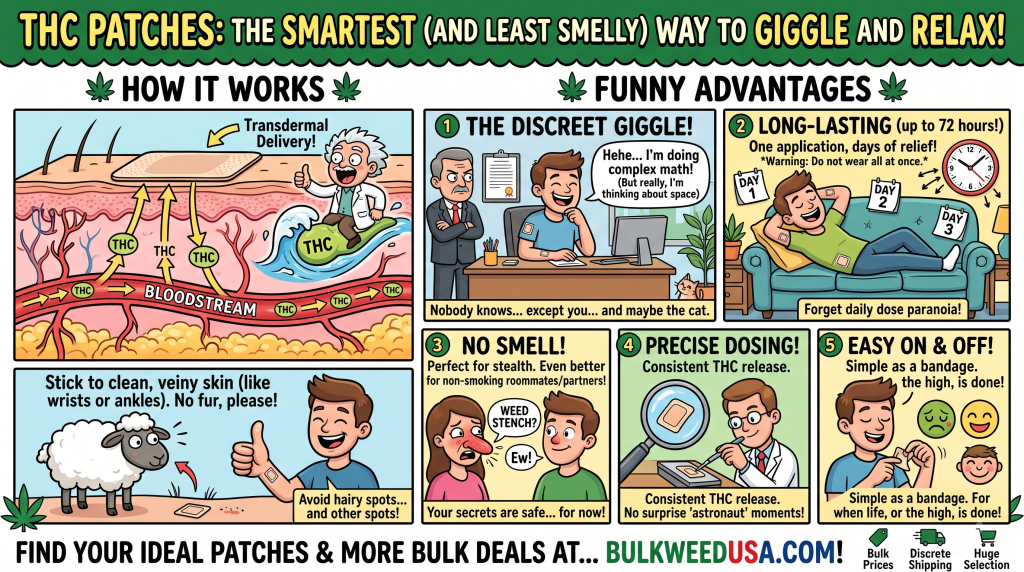
A conventional topical cannabis product is primarily applied to the skin’s surface. A transdermal formulation is specifically designed to facilitate movement of an active ingredient across the skin barrier.
That distinction is essential when researching THC patches.
How Do THC Patches Work?
Human skin provides a substantial protective barrier, making transdermal drug delivery scientifically challenging.
A review indexed by the National Library of Medicine’s PubMed database examined the potential for therapeutic cannabinoids to be delivered through the skin. The authors discuss transdermal cannabinoid delivery as an area of pharmaceutical research and note potential advantages such as avoiding first-pass metabolism.
However, that does not mean every commercially marketed THC patch has demonstrated the same absorption profile.
Formulation matters considerably.
Factors affecting transdermal delivery can include the cannabinoid, formulation, skin characteristics, patch design, concentration, and ingredients intended to facilitate penetration.
Consumers should therefore avoid assuming that every product labeled a THC patch works identically.
THC Patches vs. Cannabis Topicals
The terms topical and transdermal are sometimes casually used interchangeably, but they should be distinguished.
Cannabis Topicals
Topicals include products such as creams, balms, lotions, and salves applied directly to the skin.
They are generally formulated around localized application.
Transdermal Cannabis Products
Transdermal products are intended to facilitate movement of cannabinoids across the skin.
THC patches generally fall into this second category when they are genuinely formulated for transdermal delivery.
This distinction is more informative than simply asking whether a product contains cannabis.
Do THC Patches Cause Intoxication?
There is no responsible universal answer for every product sold as a THC patch.
If a formulation successfully delivers meaningful amounts of THC systemically, intoxicating effects may be possible because THC is psychoactive.
Actual effects can depend on dose, absorption, formulation, individual response, previous cannabis exposure, and other factors.
Consumers should therefore read regulated labels carefully and avoid driving or operating dangerous machinery if experiencing impairment.
A cannabis product being applied to the skin should not automatically be interpreted as incapable of producing systemic effects.
Are THC Patches FDA-Approved?
Consumers should distinguish commercial cannabis products from FDA-approved medications.
A product containing THC is not automatically an FDA-approved treatment simply because cannabinoids are being researched scientifically.
This distinction becomes especially important when marketing materials make claims concerning pain, inflammation, anxiety, sleep, or other health conditions.
Scientific research into cannabinoids should not be interpreted as proof that every commercially available cannabis patch has demonstrated effectiveness for treating a particular medical condition.
People seeking treatment for health problems should discuss appropriate options with a qualified healthcare professional.
Understanding THC Patch Labels
Where THC patches are legally sold within regulated cannabis markets, labels can provide important information.
Depending on the jurisdiction, consumers may encounter information about:
- THC content
- CBD content
- Total cannabinoids
- Ingredients
- Net quantity
- Batch information
- Required warnings
- Manufacturer information
- Testing or tracking information
Consumers should also distinguish between the amount of THC contained in an entire package and the amount associated with an individual patch.
Labeling requirements differ among states.
THC Patches vs. Edibles
THC patches and cannabis edibles represent very different routes of administration.
Edibles deliver cannabinoids through the gastrointestinal system.
Transdermal products attempt to move cannabinoids through the skin.
Because these routes differ, consumers should not assume that equal labeled amounts of THC will necessarily produce equivalent timing or effects.
Route of administration is one of the fundamental variables in cannabis pharmacology.
What Is Piatella Hash?
Piatella hash is a completely different cannabis category from THC patches.
Piatella is generally associated with a particular style of high-quality solventless hash that gained recognition through the European cannabis scene.
It is commonly associated with carefully processed ice-water hash and cold-storage techniques intended to preserve desirable characteristics of the resin.
It should not be confused with traditional pressed hash, vape oil, THC patches, or conventional cannabis flower.
The growing popularity of terms such as piatella hash illustrates how quickly cannabis terminology evolves.
However, descriptive terminology does not replace laboratory information.
Cannabinoid concentration and regulated testing are more reliable than appearance or product names for understanding potency and composition.
THC Patches vs. Piatella Hash
These products differ substantially.
| Feature | THC Patch | Piatella Hash |
|---|---|---|
| Product category | Transdermal cannabis product | Cannabis concentrate |
| Route | Skin | Depends on product use |
| Physical form | Adhesive patch | Concentrated resin/hash |
| Primary concern | Transdermal cannabinoid delivery | Concentrate potency and composition |
| Research consideration | Absorption through skin | Cannabinoid concentration and processing |
Consumers should not compare these products simply by their THC numbers.
They represent fundamentally different product formats.
Closest Cannabis Dispensary Near Me
The supporting phrase closest cannabis dispensary near me reflects local search intent rather than a particular cannabis product.
When researching a dispensary, proximity should not be the only consideration.
A useful distinction is:
Search engines and cannabis directories help discover businesses.
State regulators help verify cannabis licenses.
Consumers should identify the cannabis regulator responsible for their state and verify the exact retailer where official licensing databases are available.
For general cannabis terminology and educational exploration, readers can also visit Bulk Weed USA while independently checking legal and health claims against government and scientific sources.
JARS Lansing
JARS Lansing is a location-specific search associated with JARS Cannabis in Michigan.
Michigan maintains a regulated adult-use cannabis industry through its Cannabis Regulatory Agency.
Consumers researching JARS or another Michigan cannabis business can use the Michigan Cannabis Regulatory Agency — Verify a License to research adult-use establishments, medical marijuana facilities, and other regulated businesses.
That official resource is more appropriate for verifying regulatory status than relying exclusively on advertisements, search-engine listings, or consumer reviews.
JARS Port Huron
JARS Port Huron is another Michigan-specific cannabis search.
Michigan regulatory records identify JARS Cannabis licensees within the state’s regulated cannabis system, including a Port Huron licensee. Michigan’s Cannabis Regulatory Agency also publishes disciplinary information concerning licensees, illustrating why consumers should check current regulatory records rather than assuming licensing information never changes.
This provides an important lesson for any closest cannabis dispensary near me search:
Check the exact business and location.
A multi-location cannabis brand can operate through different legal entities and licenses.
What Is Weed Butter?
Weed butter, commonly called cannabis butter or cannabutter, is another cannabis category entirely.
The term generally refers to butter containing cannabinoids extracted or infused from cannabis.
It is commonly discussed in connection with cannabis edibles.
Unlike a THC patch, cannabis butter is associated with oral consumption after being incorporated into food.
Edible cannabis can have delayed effects compared with inhaled cannabis, which is one reason consumers should not assume that different routes of THC administration behave identically.
This article does not provide instructions for manufacturing cannabis butter because home production can involve legal, dosing, and safety considerations that vary by jurisdiction.
Readers interested in broader cannabis-product terminology can explore Bulk Weed USA educational resources for general information.
Greenlight Bannister
Greenlight Bannister is associated with a cannabis dispensary search in Missouri.
Missouri regulates cannabis businesses through its Division of Cannabis Regulation within the Department of Health and Senior Services.
Missouri provides a particularly useful verification system for consumers.
The state’s Missouri Division of Cannabis Regulation — Licensed Facilities page includes a verified dispensary locator and information for identifying regulated cannabis businesses.
Missouri recommends checking its licensed dispensary map and looking for the state’s Verified Dispensary decal or facility license.
This is an excellent example of why official regulatory links should accompany dispensary-directory information.
Missouri Cannabis Product Verification
Missouri also provides consumers with information for identifying regulated marijuana products.
The state’s guidance explains that regulated product labels contain facility-license information that can be checked against official records.
This matters for products such as:
- THC patches
- Cannabis concentrates
- Edibles
- Vape products
- Flower
- Pre-rolls
Exact product categories permitted and available depend on the regulated market.
The key point is that packaging and licensing information can provide substantially more useful information than promotional claims alone.
Fire Cannabis
Fire Cannabis is a broad term that can refer to a business name, brand, product description, or cannabis slang.
This ambiguity makes it a good example of why consumers should be careful with cannabis searches.
Before interpreting a search result, determine:
- Whether Fire Cannabis is a retailer or brand.
- Which state it operates in.
- Whether the exact business holds a cannabis license.
- Whether the website or directory information is current.
- Which state agency regulates the operation.
Consumers should not assume that two businesses with similar names are related.
Phoenix Dispensary
The supporting keyword Phoenix dispensary represents cannabis searches in Phoenix, Arizona.
Arizona operates a regulated adult-use cannabis market under state law, but consumers should still verify individual retailers.
Location-specific searches are particularly important because cannabis rules concerning possession, sales, operating requirements, and consumption can differ from other states.
A Michigan cannabis rule should not be applied to Arizona simply because both jurisdictions permit forms of legal adult-use cannabis.
Similarly, Missouri’s verification system is not Arizona’s licensing system.
Always research the appropriate state regulator.
Why Dispensary Licensing Matters
Cannabis legalization does not mean cannabis businesses operate without regulation.
Depending on the state, regulated dispensaries can be subject to requirements concerning:
- Licensing
- Laboratory testing
- Packaging
- THC labeling
- Inventory tracking
- Age verification
- Advertising
- Security
- Product manufacturing
- Required warnings
Missouri, for example, maintains a verified dispensary system and says regulated cannabis sold within its market must move through licensed in-state cultivation, manufacturing, testing, and transportation systems.
Michigan likewise maintains public license-verification resources.
These regulatory systems are stronger sources for determining legal status than general cannabis directories.
THC Patches and Cannabis Safety
THC remains an intoxicating cannabinoid regardless of how a cannabis product is marketed.
Effects depend on factors including concentration, route of administration, amount absorbed, frequency of cannabis use, previous experience, and individual biology.
Consumers should avoid driving while impaired.
Cannabis products should also be securely stored away from children and pets.
Anyone who is pregnant, breastfeeding, taking prescription medications, or concerned about cannabis interactions with a medical condition should seek individualized advice from an appropriate healthcare professional.
Why Scientific Evidence Matters
Cannabis marketing frequently moves faster than clinical research.
This is especially important with products such as THC patches.
The existence of scientific research into transdermal cannabinoids demonstrates that researchers are studying the route of administration. It does not prove that every commercial product has been clinically validated.
The PubMed-indexed review on transdermal cannabinoid delivery describes both the potential and technical challenges associated with delivering cannabinoids through skin.
Consumers should distinguish:
- Laboratory research
- Pharmaceutical research
- Clinical trials
- Commercial cannabis products
- Consumer testimonials
These categories provide different levels and types of evidence.
Frequently Asked Questions
1. What are THC patches?
THC patches are cannabis products designed to remain on the skin and, when genuinely transdermal, facilitate cannabinoid delivery across the skin barrier.
2. Are THC patches the same as cannabis creams?
Not necessarily. Conventional topical products and transdermal formulations are different product categories. Transdermal products are specifically formulated to facilitate movement across the skin.
3. Can THC patches cause intoxication?
Systemically absorbed THC can produce psychoactive effects. Actual effects depend on the formulation, amount delivered, individual response, and other factors.
4. Are THC patches FDA-approved medications?
A commercially available cannabis patch should not automatically be considered an FDA-approved treatment. Consumers should distinguish regulated cannabis products from FDA-approved medicines.
5. What is piatella hash?
Piatella is a term associated with a style of solventless cannabis hash. It represents a concentrate category and is fundamentally different from a transdermal THC patch.
6. What is weed butter?
Weed butter or cannabutter generally refers to butter infused with cannabinoids and is associated with edible cannabis rather than transdermal delivery.
7. How do I verify JARS Lansing or JARS Port Huron?
Michigan’s Cannabis Regulatory Agency provides an official license-verification database for researching cannabis businesses.
8. How can I verify Greenlight Bannister?
Missouri’s Division of Cannabis Regulation maintains licensed-facility information and a Verified Dispensary locator.
9. What should I look for when searching for the closest cannabis dispensary near me?
Consider current licensing, the exact address, medical or recreational status, operating hours, and applicable local regulations rather than relying solely on distance.
10. Are cannabis dispensary laws the same across the USA?
No. Cannabis laws, licenses, possession limits, product requirements, and local restrictions differ significantly among states.
Where to Explore Further
Readers researching THC patches should prioritize scientific literature for pharmacological questions and government cannabis regulators for legal and licensing questions.
The PubMed review on transdermal cannabinoid delivery provides a scientific starting point for understanding cannabinoid delivery through skin.
Consumers researching Michigan dispensaries can use the state’s Cannabis Regulatory Agency license search, while Missouri consumers can use the Division of Cannabis Regulation’s verified dispensary resources.
For broader cannabis terminology, readers can also explore Bulk Weed USA cannabis information as a general educational starting point.
Final Thoughts
THC patches demonstrate how diverse modern cannabis products have become.
Unlike cannabis flower, concentrates, or edibles, a transdermal patch is designed around cannabinoid delivery through the skin. Scientific literature continues to examine the opportunities and limitations of transdermal cannabinoid delivery, making it particularly important to separate research evidence from commercial marketing.
Supporting searches such as piatella hash, closest cannabis dispensary near me, JARS Lansing, Greenlight Bannister, weed butter, JARS Port Huron, Fire Cannabis, and Phoenix dispensary also show how a single cannabis search can cross product categories and state regulatory systems.
Consumers should therefore match the source to the question: use PubMed and peer-reviewed literature for scientific research, state regulators for dispensary licensing and cannabis law, and general cannabis resources for terminology and broader educational exploration.
